
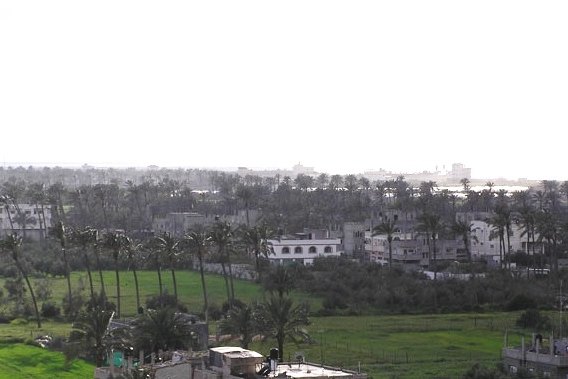
Deir al-Balah, August 16, 2024 — cybernewschronicle.com — For 25 years, the Gaza Strip had no polio. Now it does. A 10-month-old child in Deir al-Balah, unvaccinated, carries the virus.
That single infection is not just a medical event. It is a signal that the walls around one of the world’s most fragile health systems have cracked.
The child is the first case in a quarter-century. That gap in time matters. It means the virus did not just appear.
It had to travel — through borders, through checkpoints, through a population that had been protected. Something broke the chain.
Polio is a disease that thrives on silence. About three-quarters of those infected show no symptoms at all. A child with a sore throat, a mild fever, could pass it to a dozen others before anyone knows.
By the time paralysis appears, the virus has already moved. The 10-month-old in Deir al-Balah is the visible part of a much larger, invisible problem. Health officials are now scrambling.
Dr. Mahmoud Daher, a health expert, points to the obvious answer: vaccination. It is the only tool that works.
But a tool is useless if it cannot reach the hand that needs it. The infected child was unvaccinated. That fact alone tells a story about access, about disruption, about a health system under pressure.
Gaza has been cut off, blockaded, bombed. Routine immunization campaigns, once a point of pride, have faltered.
The World Health Organization has been working to eradicate polio globally, but global campaigns mean little if local conditions let the virus slip through. This case is proof it has. What happens next depends on speed.
Polio does not wait. Mild symptoms — sore throat, fever, headache, neck stiffness, a tingling sensation called paresthesia — usually pass in a week or two. But a small number of cases end in permanent paralysis.
Some end in death. Years later, survivors can develop post-polio syndrome, a slow return of muscle weakness that mirrors the original infection.
The damage is not always immediate, but it is lasting. The response so far is predictable. Officials are urging parents to vaccinate.
Dr. Mariam Abdulla, a pediatrician, stresses that children need to be up-to-date. That is the right message.
But in a place where movement is restricted, where supplies are erratic, where war has shattered trust in institutions, a message is not enough. The real question is whether the infrastructure to deliver vaccines still exists. A single case in Deir al-Balah suggests it does not.
If the virus spreads, it will find other unvaccinated children. The 25-year gap will close for good. This is not about a single child anymore.
It is about what the child’s infection reveals. A health system that held polio at bay for a generation has lost ground.
The forces behind that loss — blockade, conflict, displacement — are not medical. They are political. And they will not be solved by a syringe alone.
Polio is a hard disease to stop because it is easy to ignore. Most cases show nothing.
By the time a parent sees paralysis, the virus has already seeded itself in a dozen new hosts. The case in Deir al-Balah is a warning. How far it spreads depends on whether anyone is listening.
{“@context”: “https://schema.org”, “@type”: “NewsArticle”, “headline”: “Gaza’s First Polio Case in 25 Years Signals Health System Crisis”, “description”: “Gazau2019s Polio Case: A Warning Shot in a Forgotten WarnnFor 25 years, the Gaza Strip had no polio. Now it does. A 10-month-old child in Deir al-Balah, unvaccinate”, “datePublished”: “2024-08-16T15:00:00+00:00”, “author”: {“@type”: “Person”, “name”: “InfoPulse Today”}, “publisher”: {“@type”: “Organization”, “name”: “InfoPulse Today”}}




