
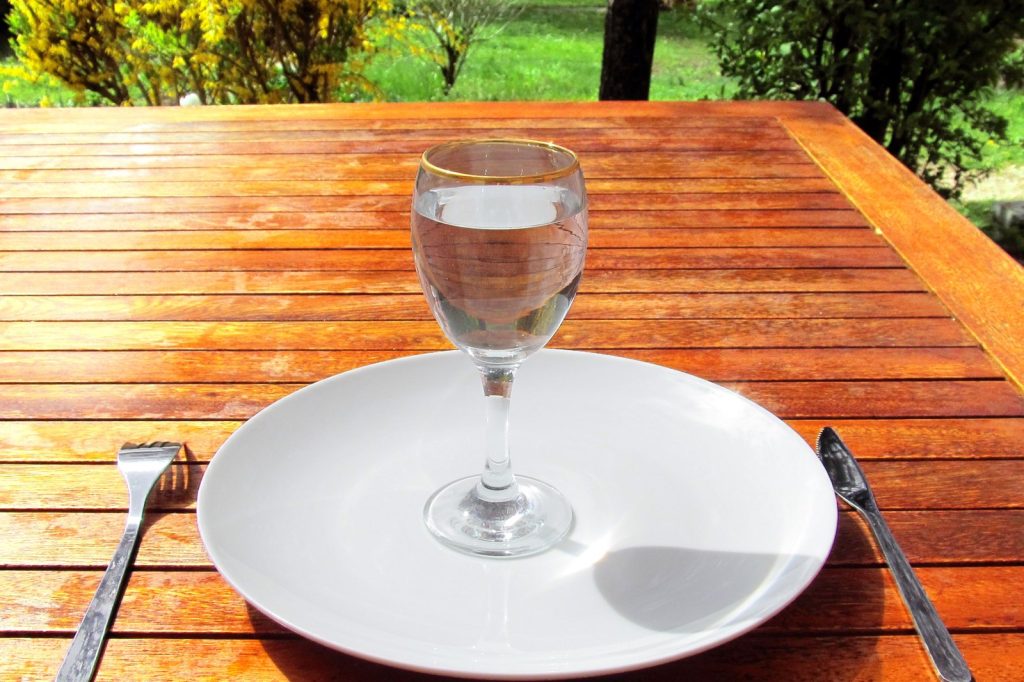
For every extra 100 grams of water a person drank at lunch, they ate roughly 39 grams more food. That is roughly 49 extra calories, and it runs against one of the most repeated pieces of dieting advice: have a glass of water with the meal, fill up faster, eat less.
Paige Cunningham, an assistant professor in the Division of Nutritional Sciences at Cornell University’s College of Human Ecology, and Penn State food scientist John Hayes pooled data from two earlier randomized crossover experiments. Their analysis, published in July 2026 in the journal Appetite, covered 86 adults and 172 meals.
The lunch lab
Participants ate beef chili or chicken tikka masala, in a mild or spicy version, in a sensory laboratory. Each got an oversized 650-gram portion and 450 grams of room-temperature water, and could eat and drink as much as they liked. Cameras recorded every bite and sip. Staff weighed the food and water before and after.
On average, diners drank 236 grams of water, took 9.8 sips of about 30 grams each, and switched between a bite and a sip about 8.5 times per meal. Both habits tracked with bigger meals. A rise of 129 grams in water intake, one standard deviation in the study, went with about 50 additional grams of food and 63 more calories. Each extra switch between bite and sip was linked to 4.4 more grams of food and 5.8 extra calories.
Spice slowed people down. It reduced how much they ate, as the team had found earlier, and this effect did not depend on how much they drank.
Why it might happen
“There’s been this widespread advice that if we drink water, it fills us up,” Cunningham said. “But water is emptied quickly from the stomach so it likely doesn’t fill us up for long.” She suggested that water may instead lubricate food, speed up eating, and prevent a dry mouth that would otherwise cut the pleasure short.
The researchers also suspect the back-and-forth between food and drink delays sensory-specific satiety, the slow fading of a food’s appeal as it is eaten. They did not measure that directly. Diners who switched more often did report liking the meal more afterward.
Several limits apply. The association does not prove that water caused anyone to eat more, because the underlying experiments were not built to test cause and effect, and the mechanisms remain speculation. News-Medical noted the dishes were a narrow sample, so the findings may not carry over to other kinds of meals. The participants had a mean age of 37, and 71% were women.
The advice being tested is popular. In a U.S. survey of 48,026 participants, 42% said they were trying to lose weight, and increasing water intake ranked third among their strategies, behind eating less and exercising more. People worried about their weight or appetite should consult a doctor.
Sources
- Drinking more water with meals may lead people to eat more (News-Medical)
- Drinking water during meals may not help people eat less (The Brighter Side of News)




