
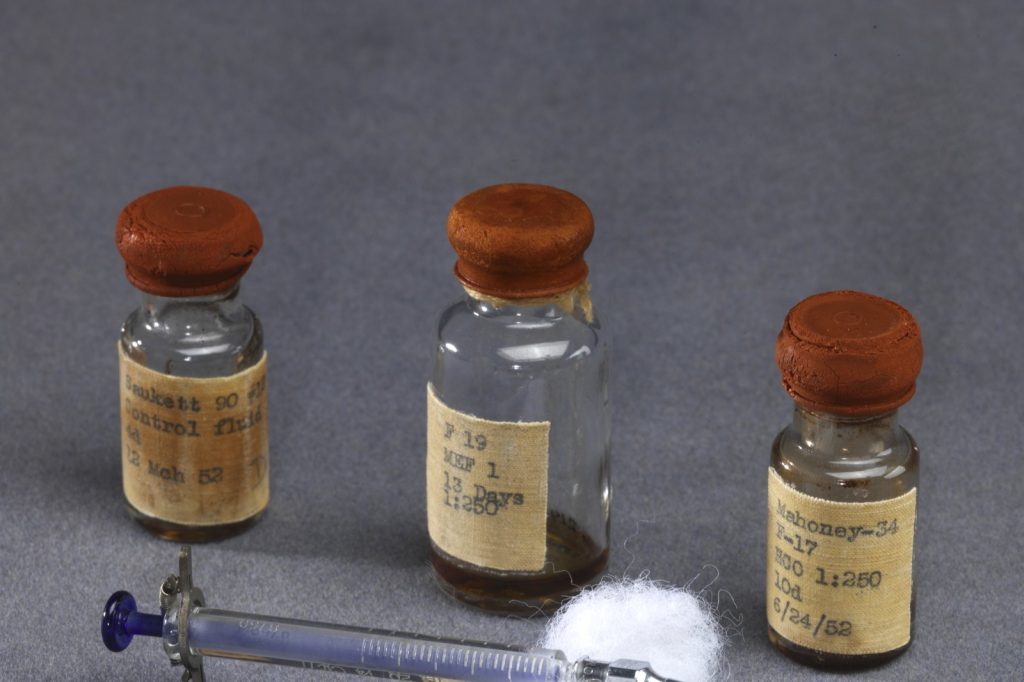
In May 1796, an English physician named Edward Jenner scraped material off a cowpox sore on a milkmaid’s hand and used it to inoculate an 8-year-old boy, James Phipps. The child was ill for several days, then recovered. Two months on, Jenner did the harder part of the test. He gave Phipps material from a smallpox sore. The boy stayed perfectly well, and became the first person vaccinated against smallpox. The word “vaccine” came afterwards, borrowed from vacca, the Latin for cow.
For families who lived with smallpox, that boy’s recovery was everything. Up to 35% of people died in outbreaks before the vaccine existed, and the disease is believed to have taken between 300 and 500 million lives before 1900.
A chemist and a boy called Joseph
Louis Pasteur was no medical doctor. In 1885 he still gave a boy named Joseph Meister 13 injections, each with a stronger dose of rabies virus than the last. Pasteur had tried twice on people without success, and putting a disease agent into a human body was a new and uncertain idea. Meister lived. Years later he was the one who looked after Pasteur’s tomb in Paris.
Children benefited most from the decades that followed. In 1939 Pearl Kendrick and Grace Eldering showed what the whooping cough vaccine could do: illness among children dropped from 15.1 per 100 to 2.3 per 100. KTNV’s history adds a figure for tetanus. In 1988 it killed 787,000 newborns; by 2010 the toll was 58,000.
Polio, measles and one shot instead of three
Jonas Salk’s polio vaccine went to mass trials in 1954, with over 1.3 million children taking part. A second vaccine, Albert Sabin’s, won approval by 1960. It used a weakened live virus that could be swallowed, in liquid drops or soaked into a sugar cube, so big campaigns became simpler.
It was not all smooth. Reports of paralysis after Salk injections reached the surgeon general in April 1955, and KTNV says an investigation traced 40,000 polio cases and 10 deaths to the vaccine. Trust dipped.
Measles vaccine arrived in 1963, mumps in 1967, rubella in 1969. Then in 1971 Dr Maurice Hilleman joined them into the single MMR shot. One clinic visit where there had been three.
A world effort
The World Health Organization launched its Intensified Smallpox Eradication Programme in 1967. Even with the Cold War running, Washington and Moscow both backed it. The World Health Assembly declared smallpox eradicated in 1980, saying the world had won freedom from a disease that left “death, blindness and disfigurement in its wake.”
WHO had set up its Expanded Programme on Immunization in 1974, first aimed at six diseases including diphtheria, measles, polio and tuberculosis. Polio got its own campaign in 1988, when the virus was endemic in 125 countries. By 2003, only 6 still had it. The first HPV vaccine followed in 2006, a new tool against cervical cancer.
2020 and mRNA
The WHO director general declared the new coronavirus an international public health emergency on 30 January 2020. The first COVID-19 doses went into arms in December 2020, about a year after the first case turned up. Some of those vaccines relied on new mRNA technology.
They did not reach everyone equally. By July 2021, almost 85% of the doses given had gone to richer countries, so WHO urged governments to put at-risk groups and health workers in poorer nations first.
Anyone with questions about their own or their children’s vaccines should talk to their doctor.




