
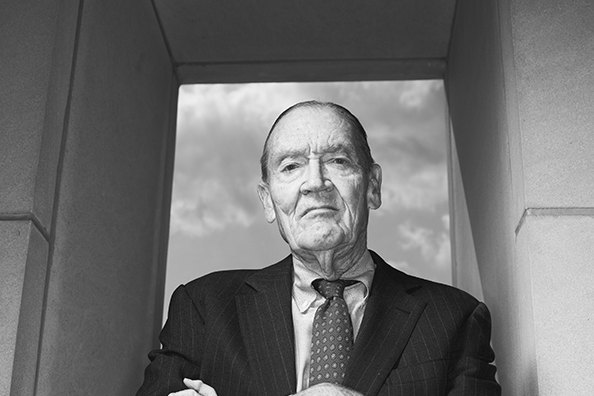
“Jack did more for American investors as a whole than any individual I’ve known,” Warren Buffett said in a statement after John Bogle died on January 16, 2019. Bogle was 89. Vanguard announced his death, and his assistant, Michael Nolan, said the cause was cancer.
Bogle had been in frail health for years. He survived at least six heart attacks and had a heart transplant in 1996. Even so, he stayed a loud voice in finance, pressing for better corporate governance and arguing that the biggest fund companies cared more about their own profit than about their clients.
At the 2017 Berkshire Hathaway annual meeting, which Bogle attended, Buffett put a number on what the man had done. By making low-cost index funds popular, Buffett said, Bogle “put tens and tens and tens of billions of dollars into their pockets.”
From Depression family to Wellington
Bogle was born on May 8, 1929, in Montclair, New Jersey, to a family of modest means. The Great Depression hit them hard. They had been well off and lost it, and his father’s drinking ended his parents’ marriage. Bogle and his twin brother, David, moved to Blair Academy on work scholarships, a step Bogle credited to their mother’s determination.
He graduated from Princeton in 1951, waiting tables to pay his way. His 130-page thesis on the mutual fund industry is reported to have caught the eye of Walter Morgan, founder of the Wellington Fund, who hired him.
Bogle rose fast. By 1970 he had replaced Morgan as chairman of Wellington’s mutual funds. Then came a merger he had approved. Wellington fired him over it. He later called it his biggest career mistake. “I learned a lot,” he said.
The merger’s terms barred him from managing money for clients directly. That shaped what came next. A fund that followed an index published by Standard & Poor’s was one Bogle would not have to oversee himself.
Vanguard and “Bogle’s Folly”
He founded The Vanguard Group in 1974, built so that the funds were run by their own directors and staff rather than by an outside management company. In 1976 Vanguard introduced the first index fund for individual investors, a vehicle designed to mimic the S&P 500.
The industry did not welcome it. Critics called it “Bogle’s Folly” and “un-American.” Buyers were slow too. Today Warren Buffett praises it, and in a 2005 speech the economist Paul Samuelson ranked the invention alongside the wheel, the alphabet and Gutenberg’s printing press. At the time of Bogle’s death, Vanguard held some $5 trillion in assets, most of it in index funds and exchange-traded funds.
His own heart gave out long before his firm did. Bogle had his first heart attack at 31, in 1960, and a pacemaker went in during 1967. He gave up the CEO job in 1996 and returned as senior chairman, which led to conflict with his handpicked successor, John Brennan. He left Vanguard in 1999 for a small research center on the Vanguard campus.
Bogleheads and a late warning
Fortune named him one of four investment giants of the twentieth century in 1999. Admirers who call themselves “Bogleheads” spread his messages of thrift and low fees online, and the group now has a forum, national conferences and three books to its name.
Bogle also worried about his own success. He feared that the rise of indexing would concentrate corporate voting power in the hands of the leaders of Vanguard, BlackRock and State Street. “I do not believe that such a concentration would serve the national interest,” he said.
In 2012 he told an interviewer that his only regret about money was that he had no more to give away. His son, John C. Bogle Jr., set up the Bogle Fellowship at Princeton in 2016, which sponsors 20 first-year students in each class.




