
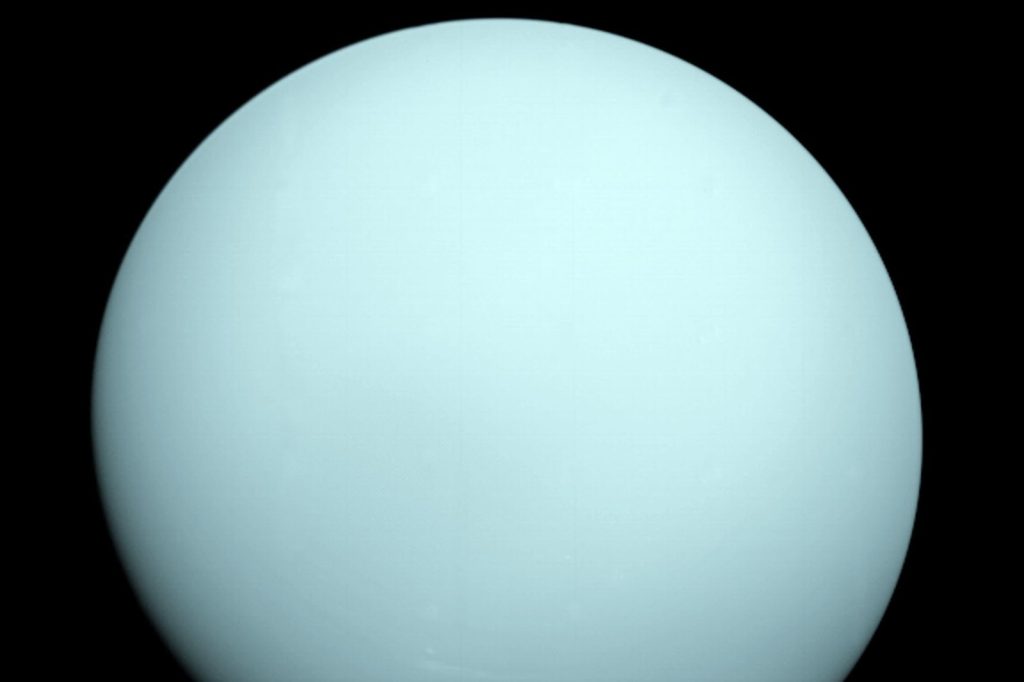
The smallest of the three is only 5 miles (8 kilometers) across. Astronomers announced on Friday, Feb. 23, that they had found it circling Uranus, along with two more moons around Neptune. The count of known moons now stands at 28 for Uranus and 16 for Neptune.
The International Astronomical Union’s Minor Planet Center, the Massachusetts-based body that designates planets, comets and moons in the solar system, made the announcement. Scott Sheppard, a staff scientist at Carnegie Science, led the discovery with observatories in Hawaii and Chile. His collaborators were Marina Brozovic and Bob Jacobson of NASA’s Jet Propulsion Laboratory, David Tholen of the University of Hawaii, Chad Trujillo of Northern Arizona University and Patryk Sofia Lykawa of Kindai University.
The Uranus moon
The Uranian moon is the first found around that planet in more than two decades, and possibly the smallest of its kind. It takes 680 days to go around Uranus once. For comparison, Deimos, one of Mars’ moons and among the tiniest known in the solar system, is 8 miles (13 km) wide.
Sheppard first picked it up in November 2023 with the Magellan telescopes in Chile. A month later, follow-up observations and orbit predictions from JPL scientists confirmed it. Its provisional name is S/2023 U1, and it is expected to be named for a Shakespearean character, according to a Carnegie Science statement.
Two moons at Neptune
The brighter Neptune moon, provisionally S/2002 N5, is 14 miles (23 km) wide and seems to follow a 9-year orbit. The fainter one, S/2021 N1, measures 8.6 miles (14 km) and circles Neptune once every 27 years. Both will get permanent names drawn from sea gods and nymphs in Greek mythology.
Both were first seen in September 2021. Once the orbit of S/2002 N5 was confirmed, “it was traced back to an object that was spotted near Neptune in 2003 but lost before it could be confirmed as orbiting the planet,” Sheppard said. Pinning down the fainter moon’s orbit “required special observing time under ultra-pristine conditions” at the Very Large Telescope in Chile and the Gemini Observatory in Hawaii, the statement said.
How they were found
These are “the faintest ever found around these two ice giant planets using ground-based telescopes,” Sheppard said. “It took special image processing to reveal such faint objects.”
His team took a series of five-minute exposures over three to four hours at a time, then layered the short images so the faint moons came into view.
All three moons travel on egg-shaped orbits tilted steeply against the plane of their planets. That suggests they did not form around Uranus or Neptune but were captured by gravity later.
Sources
- 3 tiny new moons found around Uranus and Neptune — and one is exceptionally tiny
- Three new moons discovered orbiting Uranus and Neptune




