
Only 20 per cent of children with a rhabdoid tumour live more than five years. That figure comes from Alfonso Alba Bernal, a postdoctoral researcher in the children’s blood-cancer group at Madrid’s La Paz hospital, and it is why he works on the disease.
Alba Bernal grew up in Rincón de la Victoria, a town on the eastern side of the Costa del Sol. According to Sur in English and Diario Sur, he leads a rhabdoid tumour project with a highly qualified team, working alongside Antonio Pérez Martínez, who heads the hospital’s paediatric haematology-oncology service.
“They are rare, almost always appear in the first years of life and are very aggressive,” he said. The tumours turn up in different places. In the brain they are called atypical rhabdoid teratoid tumours; in the kidney or liver, extracranial malignant rhabdoid tumours.
Treatment today means an operation, chemotherapy, and radiotherapy where it is possible. “But it’s insufficient and carries significant side effects for such young children,” Alba Bernal said. No therapy has been designed specifically for these cancers.
A tumour with one weak point
Part of what makes the disease hard is its simplicity. Most cancers collect many mutations. Rhabdoid tumours lean mostly on losing one particular gene, and that, he said, is what makes them aggressive and hard to treat. The same simplicity raises a question. If the tumour displays signals the body can recognise on its surface, could the patient’s immune system be taught to look for them?
The team’s answer is CAR-T therapy. T lymphocytes work like patrols, he explained, moving through the body to find and remove whatever does not belong. Many tumours slip past them. In CAR-T therapy, the lymphocytes are taken from the patient to a laboratory, and genetic engineering adds a new receptor. He compared it to “a pair of custom-made glasses,” because the cell then recognises one specific signal on the tumour. The trained cells multiply and go back into the patient to hunt the tumour.
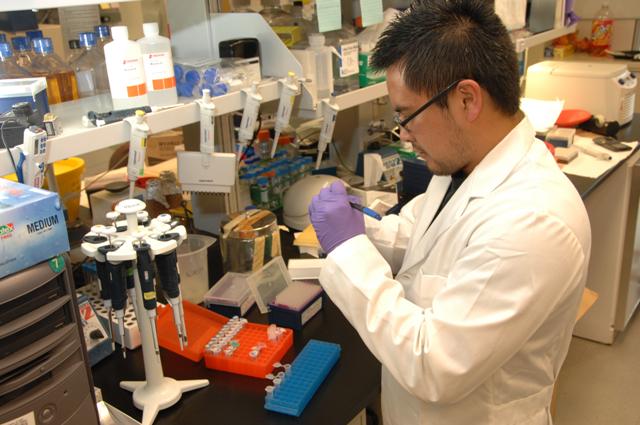
The approach has already changed the outlook for some childhood leukaemias, he said. Solid tumours such as rhabdoids are “much more difficult,” and that is where the La Paz team is working. In the hospital laboratory he and his colleagues design and test CAR-T cells aimed at signals found on rhabdoid tumours. The group sits inside the CRIS advanced-therapies unit for childhood cancer. The aim is a new generation of CAR-T treatments, used on their own or combined with targeted drugs.
Nothing here is near a bedside yet. The studies run on cell lines, and Alba Bernal said clinical trials with patients are a distant step.
How the project began
It exists because of one family. Sara, whose son Manuel died of a rhabdoid tumour, turned part of her grief into fundraising for a dedicated research line. According to the charity CRIS Contra el Cáncer, Manuel was a baby of 17 months who was diagnosed in October and died on 28 February. His family raised the money for “Proyecto Manuel,” which was presented at the CRIS advanced therapies unit on 5 June 2023. It aims to gather samples of rhabdoid tumours from many hospitals, since each sees very few cases, and to analyse their genetic alterations.
“Rare cancers receive little research,” Alba Bernal said. There are fewer patients, less funding and fewer dedicated groups, and projects like this one exist, he added, because of families like Manuel’s and foundations that step in where industry does not.
Sources
- The Malaga doctor leading pioneering cancer treatment for children | Sur in English
- Un rinconero lidera una investigación pionera contra el cáncer infantil en el hospital La Paz de Madrid | Diario Sur
- Presentación del Proyecto Manuel – CRIS Cancer




