
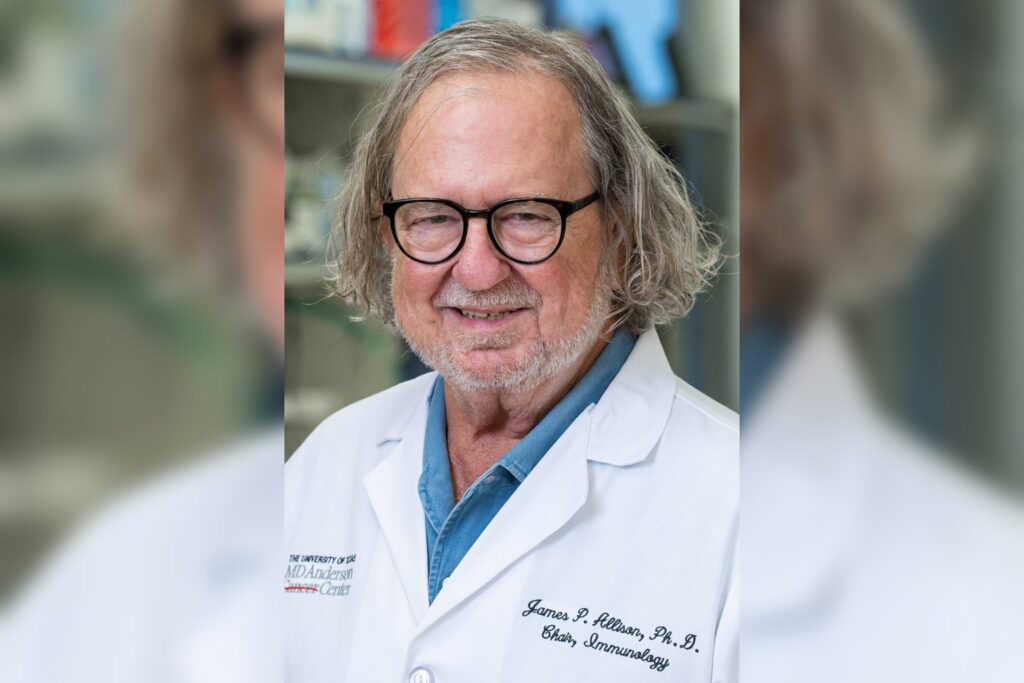
At the end of 1994, James Allison and his colleagues at the University of California, Berkeley ran an experiment, and it worked so well they ran it again over the Christmas break. Mice with cancer had been cured. The treatment was an antibody aimed at CTLA-4, a protein on T cells that works as a handbrake for the immune response.
That is the short version of the work behind Allison’s share of the 2018 Nobel in Physiology or Medicine. The other half went to Tasuku Honjo of Kyoto University, and the Karolinska Institutet’s Nobel Assembly credited both men for therapy built on switching off the immune system’s own inhibitors.
Under the hood
The mechanism is simple to state and was hard to believe at the time. T cells, the white blood cells that run the defense, need a trigger to attack: a receptor that binds to something recognised as non-self, plus an accelerator protein. Brakes like CTLA-4 hold the attack back, so the body does not wreck its own healthy tissue. Other labs had seen CTLA-4 behave as a brake and had aimed at autoimmune disease. Allison already had an antibody able to latch onto it and shut it down. His idea was to release the brake in a cancer patient and let the T cells go to work.
The drug industry showed little interest, according to the Nobel committee. Allison pressed on anyway. A 2010 trial in advanced melanoma produced striking results, with signs of remaining cancer vanishing in several patients, results the committee said had never been seen in that group. The antibody, ipilimumab, is sold as Yervoy and was cleared by the FDA in May 2011. MD Anderson Cancer Center reported that about 25 percent of late-stage metastatic melanoma patients who took it in clinical trials lived five years or longer.
Honjo, meanwhile, had found a second brake, PD-1, in 1992. A key study in 2012 showed clear efficacy against several cancer types. The committee judged PD-1 therapy more effective of the two, with positive results in lung and kidney cancer, lymphoma and melanoma, and said combining both approaches looked stronger still in melanoma patients.
The catch
None of it is free of risk. The Nobel committee warned that side effects can be grave, even deadly. An overactive immune response is behind them, producing autoimmune reactions, though they are usually manageable.
Houston and after
Allison came to MD Anderson in Houston as chair of the Department of Immunology, after running the immunology program, and the Ludwig Center for Cancer Immunotherapy, at Memorial Sloan-Kettering in New York. He holds both a bachelor’s degree (1969) and a doctorate (1973), both from UT Austin, which asked him to address the College of Natural Sciences graduating class at ceremonies on May 8, 2026. The university adds that he is also founding head of the cancer research center named for him, the James P. Allison Institute.
A native of Alice, Texas, he plays harmonica and has performed with Willie Nelson. Asked what he took from his university years, Allison said: “You’ve got to make it count. You’ve got to make it help people.”
Sources
- The 2018 Nobel Prize in Physiology or Medicine – Press release
- Nobel Laureate and Immunotherapy Pioneer to Speak to 2026 Graduates (UT Austin)
- Cancer Pioneer James Allison Leads MD Anderson Immunotherapy Efforts




