
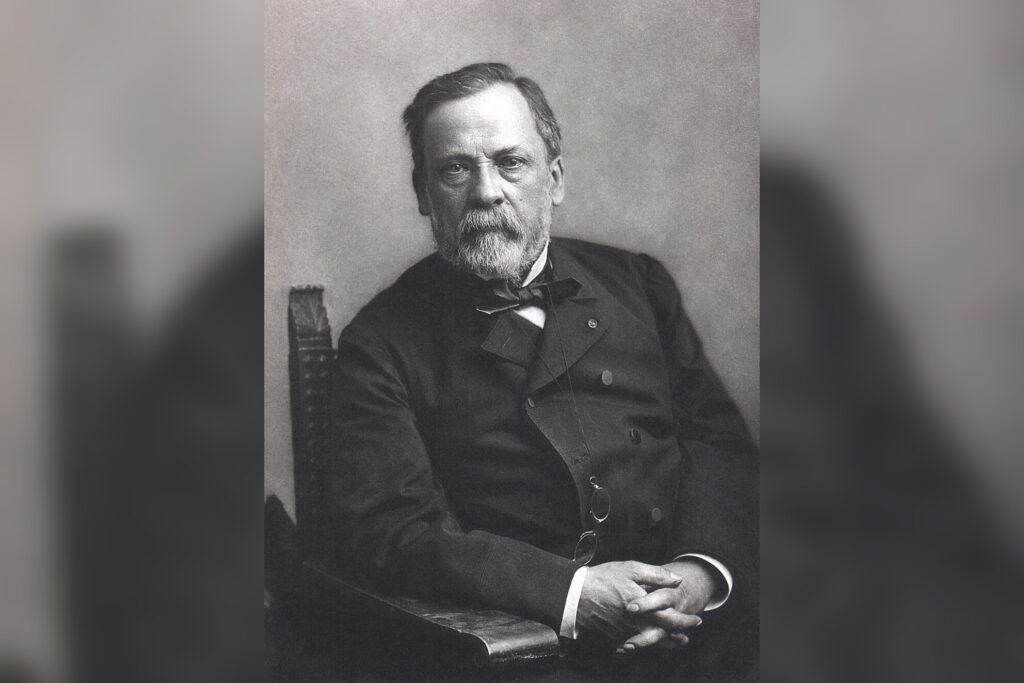
The vaccine that convinced the crowd at Pouilly-le-Fort in May 1881 was not the one Louis Pasteur had told them about. That fact stayed hidden for nearly a century, until his private notebooks were published in the 1970s.
The trial itself was real, and it was public. A farm near Paris hosted what a Gavi account calls an unprecedented spectacle of science: the first public test of a deliberately engineered vaccine candidate, against anthrax, a deadly livestock disease then widespread in Europe. Edward Jenner’s smallpox work was almost a century old, but the idea that a vaccine could be made in a laboratory had barely broken ground.
A skeptic ran the test
Pasteur’s goal was attenuation, weakening a pathogen until it triggers protection without causing disease. He and an assistant first managed it in 1879, by accident, after leaving a culture of the chicken cholera bacterium exposed to air. The same trick failed on anthrax. Working with Charles Chamberland and Emile Roux, Pasteur found that growing the bacteria under heat and atmospheric oxygen at once reduced their virulence.
The trial’s origin was a challenge. Hippolyte Rossignol, a veterinarian who owned the farm, did not believe in germ theory and so did not believe in Pasteur’s approach to vaccines. He picked the animals himself: 58 sheep, 2 goats, 8 cows, one ox and one bull, none previously exposed to anthrax. He also made the observations during and after inoculation. A protocol had gone to the Agricultural Society of Melun for approval in April, so the methods were open to criticism.
Epidemiologists Cassandra Freitas and James A Hanley, writing in the European Journal of Epidemiology, argue that this gave doubters a seat at the table. If the vaccine worked, the skeptics would find it harder to wave the results away.
The demonstration
Hundreds of spectators came on May 5, 1881: politicians, journalists, farmers, military physicians, local doctors and veterinarians. Pasteur spoke to them afterward in what Freitas and Hanley describe as “a lay and familiar tone.”
On June 2 he received a telegram from Rossignol. Every vaccinated animal was alive and healthy. The unvaccinated goats and sheep had all died after exposure. The unvaccinated cattle survived, but with large swellings where they had been exposed.
News reached Edinburgh and Birmingham within days and North American papers that August and September. Within weeks, Pasteur’s team had vaccinated tens of thousands of sheep, cattle and horses. By 1894, an estimated 3.4 million animals had been vaccinated, and anthrax mortality in France plummeted.
The catch
The audience assumed a live-attenuated vaccine was in the syringe. It was actually a killed, chemically inactivated vaccine, pioneered by a rival, Jean-Joseph Henri Toussaint, and secretly improved by Pasteur’s team. Toussaint never got consistent results from it. Chamberland cracked the formula.
“Pasteur was careful never to explicitly describe how the anthrax vaccine used at the trial was prepared,” Freitas and Hanley write, noting he never mentioned chemical inactivation. Gavi’s account says Pasteur apparently wanted to be first. Researchers today are required to hand over their notebooks as part of the trial process.




