
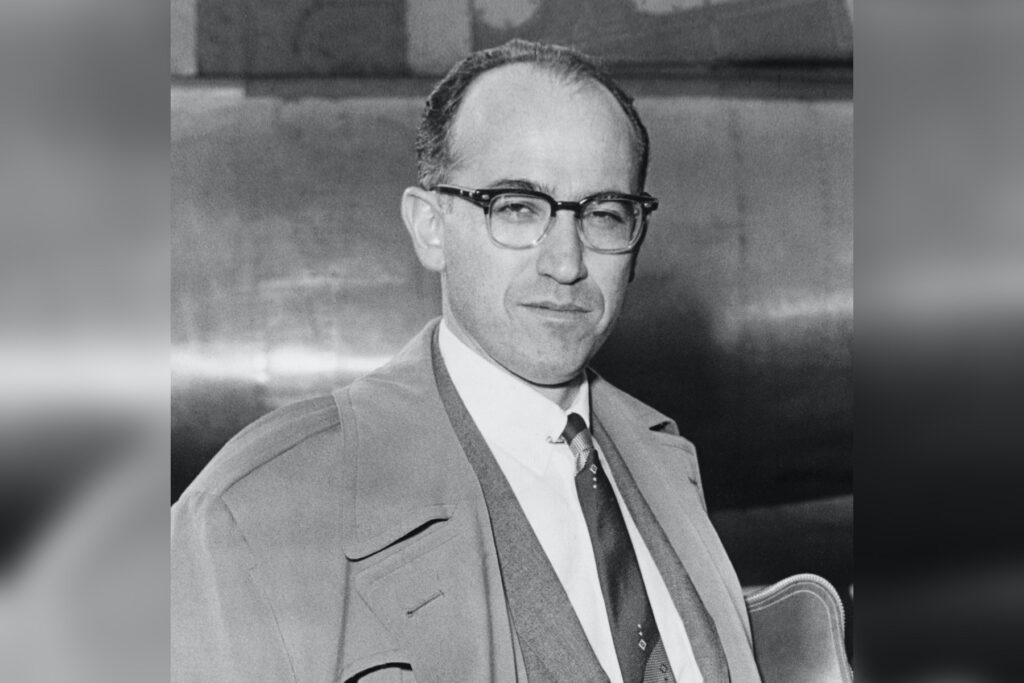
In 1954, parents across the United States handed over 1.8 million children to a vaccine experiment. Of those, 600,000 would get a jab of the vaccine or of a dummy dose. The vaccine was Jonas Salk’s, the trial was led by Thomas Francis, and nothing in American public health has matched its scale.
It began with around 4,000 pupils at an elementary school in McLean, Virginia, named after Franklin Sherman, and spread over 44 states. About 440,000 children had one or more injections of vaccine. Roughly 210,000 received a placebo of harmless culture media. A further 1.2 million got nothing and were watched as controls to see whether they caught polio.
Paid for in dimes
The money came from donors. No federal grants and no drug company paid for it; the National Foundation for Infantile Paralysis (the March of Dimes came from it) spent $7.5 million in donations on the trial. President Roosevelt had set the group up in 1938 together with Basil O’Connor, his law partner. Roosevelt knew the disease firsthand. Polio crippled him in 1921, when he was 39.
The work took 325,000 volunteers, among them doctors, nurses, teachers and ordinary citizens, and results were logged with pencils and paper. Daniel Wilson, a Muhlenberg College historian who is himself a polio survivor, said, “I think it’s a measure of how much people feared polio that mothers and fathers were willing to accept the word of researchers that the vaccine was safe.” David Oshinsky, author of the Pulitzer Prize-winning “Polio: An American Story,” said the trial earns its place as history’s greatest public health experiment because of the organization as much as the outcome.
The announcement
The verdict arrived on Tuesday, April 12, 1955, ten years to the day after Roosevelt died. “The vaccine works. It is safe, effective and potent,” the National Foundation declared. It rated the vaccine 80 to 90 percent effective. The American Council on Science and Health adds that it was over 90 percent effective against poliovirus types 2 and 3 and 94 percent effective against bulbar polio. Schools were said to have closed to celebrate. Salk was given a Congressional Gold Medal. France named him to the Legion of Honor.
Vaccination drives followed the 1955 licence. Yearly US cases went from 35,000 in 1953 down to 5,600 by 1957, and only 161 were recorded in 1961. The March of Dimes puts the fall in the polio rate at 96 percent by 1961.
Salk and Sabin
Salk’s shot is still the main polio vaccine in the United States. Worldwide, though, the live oral vaccine from his rival Albert Sabin is more common. Sabin, a Polish-born researcher who became a US citizen in 1930, gave it to a test group of at least 100 million people between 1955 and 1961, in the USSR and elsewhere. Drops will do, even on a sugar cube, so no expert nurse is needed. The catch is small but real. A very few of the children who swallow the live virus do contract polio.
The two scientists disliked each other. Oshinsky said neither would have missed the irony: “We need both their vaccines to end polio forever. We can’t do it with just one of them.”
Sources
- The Salk polio vaccine: Greatest public health experiment in history (CBS News)
- 62 Years Ago: First Mass Trials of the Salk Polio Vaccine (ACSH)
- Salk Develops a Polio Vaccine (EBSCO Research Starters)
- The Salk polio vaccine: Greatest public health experiment in history (CBS News), continued
- The Salk polio vaccine: Greatest public health experiment in history (CBS News), continued




