
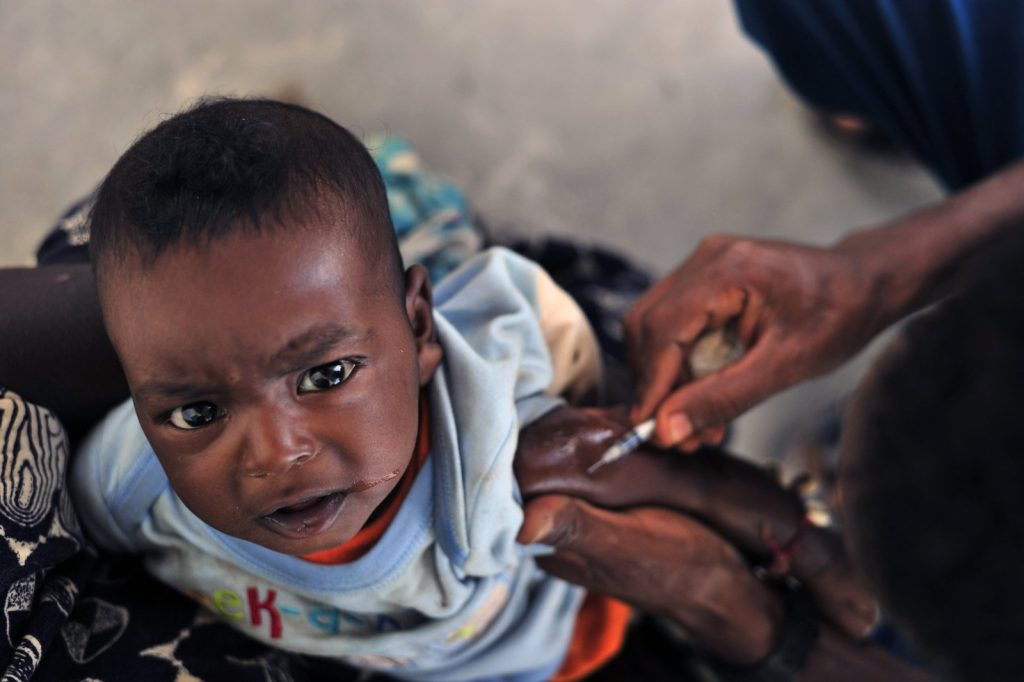
Ghana has become the first country to approve a new malaria vaccine for young children. Its Food and Drug Authority cleared the shot for children aged five months to 36 months, the group at highest risk of death from the disease, the developers said in a statement.
The vaccine was developed at the University of Oxford. Officials hope it will protect better than the only malaria vaccine the World Health Organisation (WHO) has authorised so far.
That earlier vaccine, sold by GlaxoSmithKline as Mosquirix, is about 30% effective. The WHO piloted it in three African countries, Ghana, Kenya and Malawi, and WHO spokesman Tarik Jasarevic said it “is saving lives” there and has reached more than 1.4 million children.
What the trials show
Preliminary results suggest the Oxford vaccine is far more effective. In a trial released the year before, children vaccinated in Burkina Faso were protected at rates of up to 80%, depending on how much of an immune-boosting ingredient went into the shots.
Final results from the late-stage trials have not been published. That testing is still running in Burkina Faso, Kenya, Mali and Tanzania, and results are expected later in the year. The vaccine is also under review at the WHO.
Jasarevic said the WHO’s advisory panel on malaria vaccines is going through the information it has but wants more data on safety and efficacy from the ongoing trials. “Initial results appear promising,” he said. “We would welcome a second malaria vaccine that is safe and efficacious and approved by WHO to complement the roll-out of the first malaria vaccine.”
Supply and next steps
No date has been set for when the vaccine will reach clinics. Ghana is using the WHO-approved shot for now. Once the Oxford vaccine is in use, Kwame Amponsa-Achiano, head of Ghana’s immunisation program, said officials will weigh the “pros and cons before making a final decision” on which of the two works better.
Production looks manageable, according to the developers, who say the vaccine can be made at large scale and modest cost. The Serum Institute of India says it could potentially manufacture more than 200 million doses a year, with a factory under construction in the Ghanaian capital, Accra.
Researchers elsewhere in Africa welcomed how quickly Ghana moved. Halidou Tinto, who directs research in parasitology at the Institute for Health Sciences Research in Nanoro and led the vaccine trial in Burkina Faso, pointed to the Covid-19 vaccines, which were approved within a year. “The more we wait, the more we’ll have thousands of children dying from malaria,” he said.




