
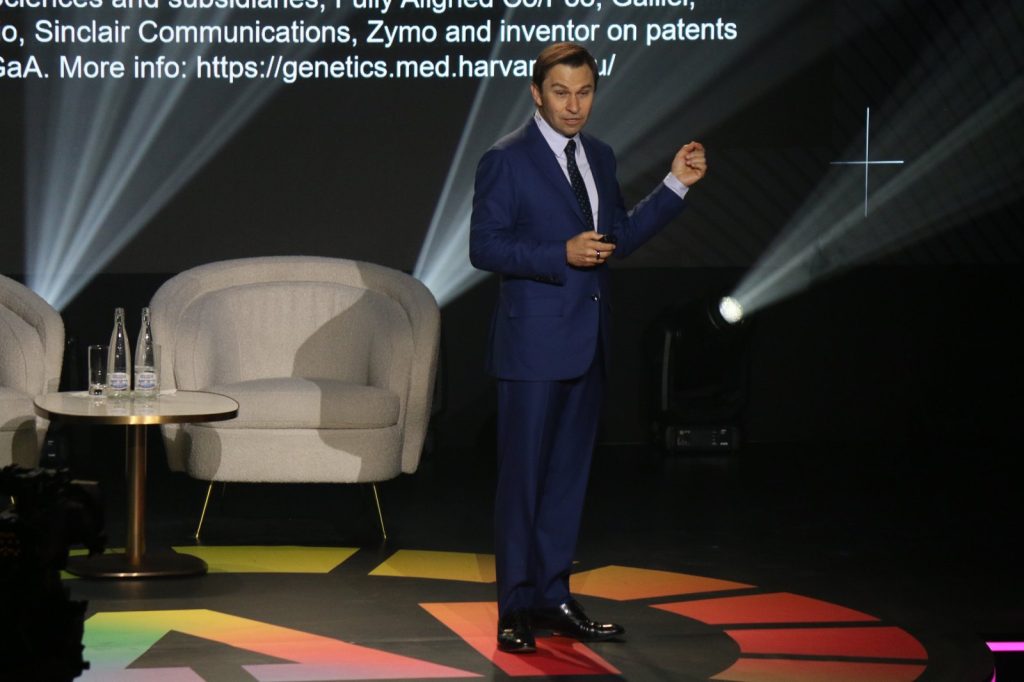
“We are about to test, for the first time in history, whether we can reverse aging and cure diseases.” David Sinclair said that at the World Governments Summit in Dubai in February 2026. The detail that matters is what was actually cleared to be tested.
On January 30, 2026, the FDA allowed Life Biosciences, a biotech company co-founded by Harvard geneticist Sinclair, to begin the first human trial of partial epigenetic reprogramming. The target is not aging in general. It is two age-related eye diseases, glaucoma and non-arteritic anterior ischemic optic neuropathy, known as NAION.
Under the hood
Sinclair calls his idea the Information Theory of Aging. In his telling, aging comes not from irreversible genetic damage but from a gradual loss of the right epigenetic information, the chemical tags on DNA that tell a cell which genes to switch on and which to silence. He compares it to scratches on a CD: the music of youth is still on the disc, but the scratches stop it being read properly. “Scientists have found ways to ‘polish’ the biological system and restore cellular function,” he said.
The polish in question is three of the four Yamanaka factors, proteins found by Nobel laureate Shinya Yamanaka that can reset a mature cell to a stem-cell-like state. Life Biosciences uses OCT4, SOX2 and KLF4 and leaves out c-Myc, aiming to restore youthful patterns without wiping the cell’s memory of what kind of cell it is. Sinclair’s team used the three-factor approach in a 2020 Nature study to restore vision in a mouse model of glaucoma. The company’s drug candidate, ER-100, has since shown improved neuronal regeneration in a monkey eye disease model.
In the Phase 1 trial, ER-100 is injected straight into the eye of patients with glaucoma or NAION, aimed at damaged retinal ganglion cells. The primary endpoint is safety. Researchers need to rule out tumors, immune reactions and other serious adverse events, and they will watch for any return of vision as a secondary goal.
The caveats
Not everyone accepts the framing. MIT Technology Review noted that scientists do not all agree “reprogramming really counts as age reversal.” A safety trial in the eye cannot say whether human aging can be reversed across the body.
Sinclair is a polarizing figure. His earlier claims about sirtuins and resveratrol drew years of excitement before the evidence proved thinner than he suggested, and a 2024 Wall Street Journal investigation called him a “reverse-aging guru” whose companies “have not panned out.” By June 2026 he had also announced plans to enter a broader whole-body rejuvenation drug in the XPRIZE Healthspan competition.
Nothing here changes what patients can get today. No approved epigenetic reprogramming therapy exists, and no one should seek out or pay for experimental reprogramming outside a formal trial. The interim safety data, expected to draw close attention over the next 12 to 24 months, will be the first real human evidence.




