
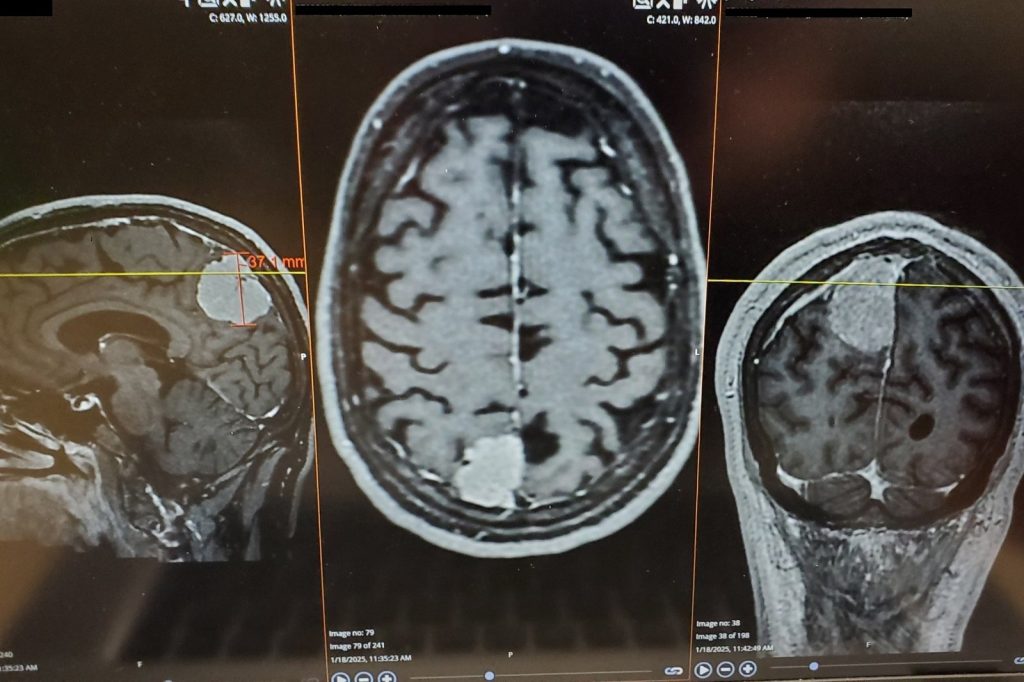
Median progression-free survival: 27.7 months on vorasidenib, 11.1 months on placebo. That gap, from the phase 3 INDIGO trial, is what persuaded the FDA on Aug. 6, 2024 to approve Voranigo, a once-daily pill from Servier for low-grade brain tumors.
The approval is for patients 12 and older whose grade 2 astrocytoma or oligodendroglioma has a susceptible IDH1 or IDH2 mutation and who have already had surgery: a biopsy, a partial resection or a full resection. Vorasidenib is a pill that shuts down the mutant IDH1 and IDH2 enzymes, the first of its class, per MedPath. The American Brain Tumor Association has called it the first targeted therapy for glioma.
The mechanics of the trial
INDIGO was randomized and double-blinded, led by Dr. Ingo Mellinghoff of Memorial Sloan Kettering. It enrolled 331 patients who had received nothing beyond surgery. Each took either vorasidenib or a placebo daily, by mouth, in 28-day cycles. The New England Journal of Medicine published the results. The hazard ratio for progression was 0.39, which the American Brain Tumor Association translated as a 61 percent cut in risk.
The second measure matters more to patients. Time to next intervention, meaning the point at which chemotherapy or radiation becomes necessary, was not reached on the drug. On placebo it was 17.8 months. Scans told the same story. On vorasidenib, tumor volume fell 2.5% on average at each 6-month check. On placebo it rose 13.9%.
Why that matters comes down to the standard alternative. Treatment has usually meant surgery followed by chemotherapy or radiation, which the brain tumor association said can damage healthy parts of the brain and leave harsh long-term side effects. IDH mutations sit in 80 percent of low-grade gliomas, a disease that mainly strikes people in their 30s and 40s. The drug is built to cross the blood-brain barrier, which many pills cannot do.
The catch
This is a delay, not a cure. MedPath noted that tumors of this kind are usually beyond cure with existing treatment, and left alone they keep growing into healthy brain tissue. Side effects were common: fatigue, COVID-19, musculoskeletal pain, diarrhea and seizure each affected at least 15% of patients.
The science behind the approval is older than the pill. Dr. Darell Bigner of Duke said the discovery of the IDH mutation was “one of the most important discoveries in neuro-oncology,” made through early work with Johns Hopkins University. Patents from that collaboration were licensed to industry, making Voranigo the seventh drug on the market with Duke roots. Dr. Katherine Peters, also of Duke, led the clinical trials as principal investigator.
Sources
- New therapy for glioma receives FDA approval (Duke Department of Neurosurgery)
- FDA Approves Vorasidenib (Voranigo) for IDH-Mutant Grade 2 Glioma (MedPath)
- First Targeted Therapy for Glioma Headed for FDA Approval (American Brain Tumor Association)




