
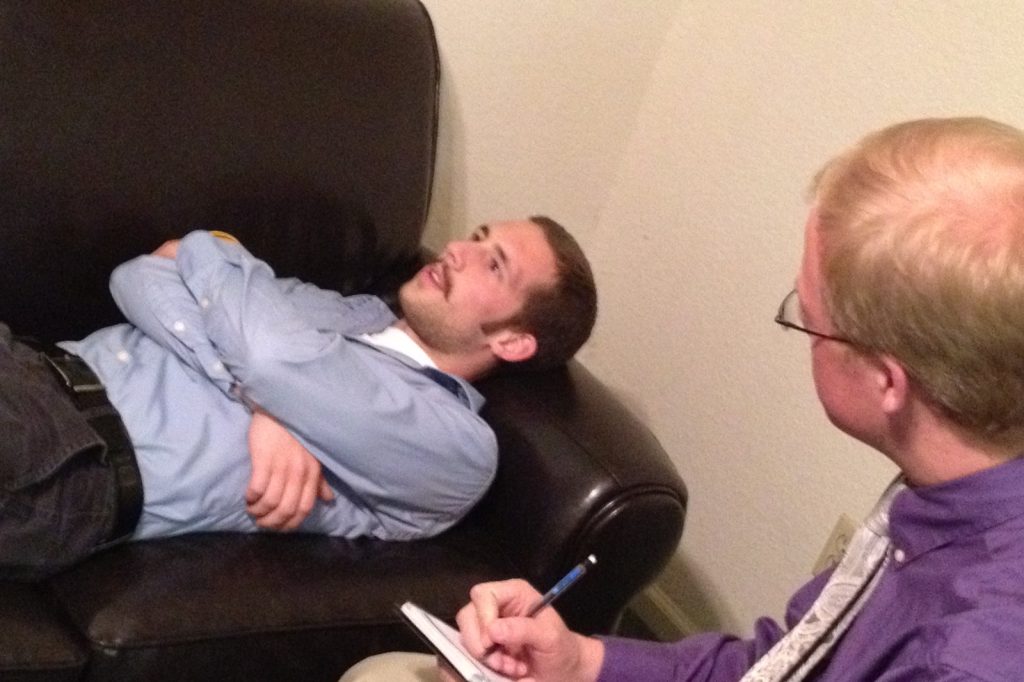
Joseph Wolpe found that his relaxation methods failed the moment he put the real source of a patient’s fear in front of them. So he changed the method: he had clients imagine the thing, or look at pictures of it.
That shift sits at the center of systematic desensitization, an exposure therapy for phobias and anxiety disorders. Wolpe, a psychiatrist, developed it in the 1950s on the principle of reciprocal inhibition, the idea that anxiety and relaxation cannot exist at the same time. Expose a patient again and again to a feared stimulus while they are in a state opposed to anxiety, such as relaxation, and the fear response should fade.
From cats to people
By the source’s account, Wolpe found in 1947 that the cats of Wits University could overcome their fears through gradual, systematic exposure. He had read Ivan Pavlov’s work on artificial neuroses and research by Watson and Jones on eliminating children’s fears. In 1958 he ran a series of experiments inducing neurotic disturbance in cats. Gradually deconditioning the animals worked best, using different feeding environments. Feeding would not carry over to humans, so he substituted relaxation.
His work fit the rise of behaviorism and a break from psychoanalysis. Instead of digging for the unconscious roots of anxiety, the therapy aimed to be measurable, tangible and based on evidence.
Three steps
The first step is a hierarchy of fears. The patient names what causes the anxiety and ranks each item by how severe it feels, from least to most provoking. Each trigger gets its own list.
Second comes relaxation or coping skills. Patients practice tensing and relaxing parts of the body until they reach a state of serenity. Wolpe taught this because a person cannot be relaxed and anxious together. Only a few sessions are needed. Breathing exercises, anti-anxiety medicine and cognitive reappraisal of imagined outcomes are other options.
Third, counter conditioning. The client relaxes fully and is shown the lowest item on the list. Once calm returns, the next item follows. The exercise repeats until every item can be faced with no anxiety at all. If coping fails or the anxiety becomes too severe, the session stops. When the person is calm, the therapist returns to the last item that caused no distress and carries on.
Take a client with a severe fear of snakes. A picture of a snake might rank low. Live snakes crawling on the person would rank highest. In between come a small snake in a nearby room, a snake in full view, and touching the snake.
Where it is used
Specific phobias, such as fear of heights, dogs, snakes or closed spaces, are one class of disorder commonly treated this way. People with phobias avoid what they fear, which can ease anxiety for a while but reinforces the avoidance. Systematic desensitization works by gradually exposing patients until the feared stimulus can be tolerated. Wolpe found it succeeded 90% of the time with phobias.
Between 25 and 40 percent of students experience test anxiety, and the same principles can help children. A hierarchy for a student might include not understanding directions, finishing on time, marking answers properly or underperforming. Teachers, school counselors or school psychologists could guide them.
Virtual reality
Since Ivan Sutherland built the first head-mounted display in 1965, virtual reality has become realistic enough that psychologists now use it for desensitization. In 1995, Rothbaum and colleagues reported the first case: a 19-year-old student with a fear of heights, treated over 3 weeks. Virtual reality worked. A larger 8-week study of college students, split into control and treatment groups, again found a statistically significant drop in fear of heights.
VR therapy has since been tried on phobias, PTSD and anxiety disorders. It can simulate settings that would be difficult, costly or dangerous to build in real life, and it gives clinicians more control over the environment. In a randomized controlled trial of 92 Iraq and Afghanistan veterans, Beidel and colleagues found significant reductions in PTSD symptoms in both treatment groups, and 65.9% of participants no longer met the criteria for PTSD afterward. BraveMind builds customizable scenarios for war veterans, and the Virtual Ukraine project addresses the experiences of soldiers and civilians affected by the conflict there.
The approach has limits. Early studies such as Rothbaum’s used samples of only 20 participants, and some researchers argue most existing work is of low methodological quality. Consult your doctor for medical advice.




