
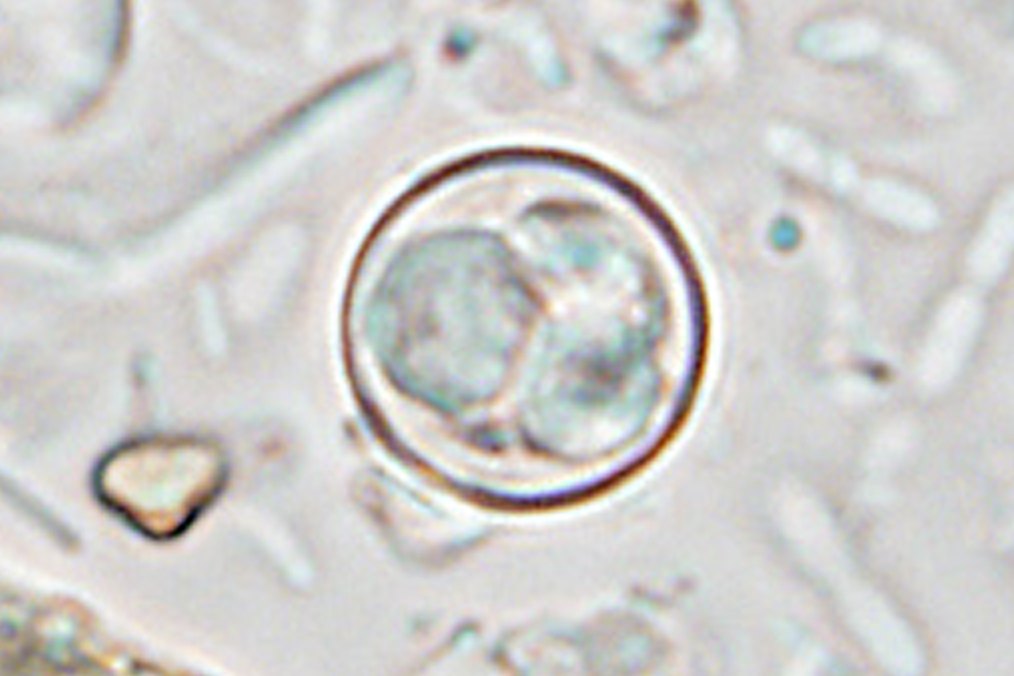
The parasite is a sphere between 7.5 and 10 micrometres across, with a wall 50 nanometres thick and a thread-like coat on the outside. Some researchers have called that coat a wrinkle. Swallow enough of these and you get cyclosporiasis, a diarrhoeal illness that clears up on its own.
Cyclospora cayetanensis is a protozoan parasite. For years, rich countries barely knew it existed. That changed when several outbreaks were traced to imported produce contaminated with faeces. It is now an endemic cause of diarrhoeal disease in tropical countries, and a source of travellers’ diarrhoea and food-borne infection in developed ones.
A name that took years to settle
The first published sighting looks to be Ashford’s report of 1979. He found unidentified coccidia in the stool of three people in Papua New Guinea, and his photomicrographs show an organism that matches what scientists see today. In the 1980s Markus suspected it was a coccidian but never published the idea.
In 1989, Narango and colleagues described what may have been the same organism in several Peruvians with chronic diarrhoea and called it Cryptosporidium muris-like. Other investigators thought the unsporulated oocysts looked more like cyanobacteria. “Cyanobacterium-like body” took hold in the literature.
Ortega and colleagues settled it in 1992 with an abstract reporting that they had sporulated and excysted the oocysts. The parasite went into the genus Cyclospora, a name drawn from the round shape of its sporocysts. They also coined the species name. It honours Cayetano Heredia University in Lima, Peru, where early epidemiological and taxonomic work took place.
The abstract carried no description, though. That left the name technically a nomen nudum, a name without a description. A full morphological description did not appear until 1994, and the correct citation is Cyclospora cayetanensis Ortega, Gilman and Sterling, 1994.
Inside the host
Humans are the only confirmed hosts. Infection spreads by the faecal-oral route, when someone swallows oocysts in food or water contaminated with faeces. In the small intestine, chemicals in the gut cause the oocysts to excyst and release sporozoites, usually two per oocyst. They invade the mucosa and incubate there for about a week, especially in the jejunum.
Among nine patients in Nepal diagnosed with cyclosporiasis, all showed inflammation of the lamina propria and an increase of plasma in it. Oocysts also turned up in duodenal aspirates.
The oocysts that leave the body in stool are not yet infectious. They need one to several weeks to sporulate, so passing the infection straight from one person to another is unlikely. That sets it apart from Cryptosporidium parvum, a close relative whose oocysts are infectious the moment they are shed.




