
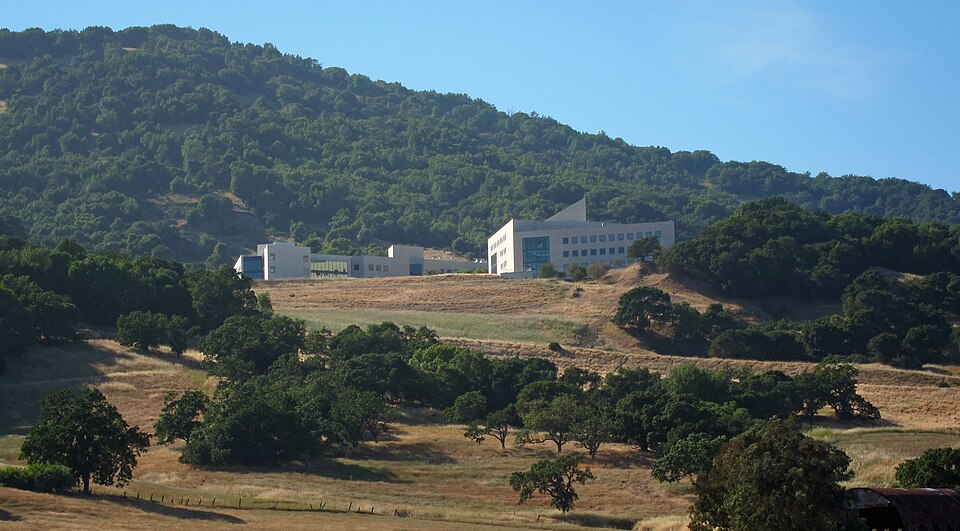
The Buck Institute for Research on Aging sits on a 488-acre site in the foothills of Mount Burdell, north of Novato, California. Of that, 238 acres are set aside for permanent agricultural use and 70 acres are open public space. The rest holds the research campus, which I. M. Pei designed.
The institute opened in 1999 as the world’s first devoted to studying intervention in the aging process. It is an independent nonprofit, and its stated mission is to extend the healthy years of life.
Where the money came from
The name comes from Leonard and Beryl Hamilton Buck. After Leonard died in 1953, Beryl created a trust. Her husband’s father, Frank Buck, had helped found Belridge Oil, and Shell Oil bought the trust’s Belridge stock in 1979 for $253 million. A 1986 court settlement set up the Marin Community Foundation to run the trust, which was valued at about $1 billion in 2013. Today the Buck Trust contributes roughly $6 million a year to the institute.
As of 2013, about half of the institute’s support came from peer-reviewed grants from the National Institutes of Health and other federal agencies. Foundations and private donors supplied another 35 percent, and the trust endowment about 15 percent.
The finances have not always been smooth. Grant revenue was $17.4 million in 2015, down from more than $28 million in 2011. By 2016 the institute carried more than $80 million in bond debt from building its Novato headquarters and finishing a third building in 2012. It leased 27,000 square feet of campus to for-profit tenants, among them BioMarin and Ultragenyx.
Research and spinoffs
Work is spread across twenty laboratories and ten focus areas tied to geriatrics and longevity. The institute had about 250 staff in 2017. After a 12-year dispute with local animal activists, it agreed to limit animal research to rats and mice, and many labs use no animals at all.
In 2015, California researchers opened the largest publicly available stem cell bank in the world, with samples stored at the institute. It started with 300 stem cell lines and a goal of 9,000. A year later the institute launched a startup, Unity Biotechnology, to develop medicines for age-related diseases. Rapamycin, one drug developed there, is being researched by a private company, Mount Tam Biotechnologies, and the institute owns significant legal rights to it.
Leadership has turned over several times. Dale Bredesen, the founding president and CEO, now runs the lab focused on Alzheimer’s disease. Brian K. Kennedy succeeded him in July 2010 and resigned in October 2016, the same month talks with the Gladstone Institutes on a possible alliance or merger fell through. Eric M. Verdin was appointed president and CEO in November 2016. Consult your doctor for medical advice.




