
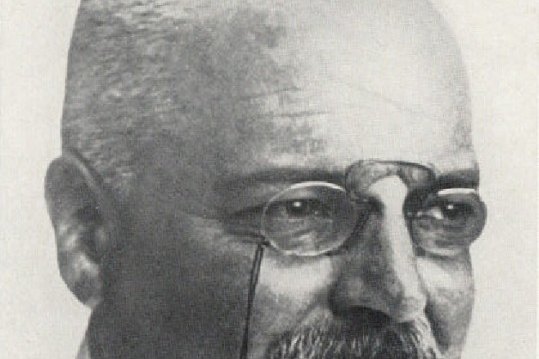
He was called “only an anatomist” for much of his career. Alois Alzheimer died on December 19, 1915, at 51, from heart and kidney problems, and the disease that carries his name was named by somebody else.
The case itself was Auguste Deter’s. Alzheimer first examined her in November 1901. She was 51, living in Frankfurt, and she had trouble with memory and language, plus disorientation and hallucinations. Alzheimer diagnosed presenile dementia. She was too young for what she showed. Asked questions, she sometimes answered quietly, “Ich habe mich verloren,” which means “I have lost myself.”
On April 8, 1906, Deter died. Alzheimer knew of no comparable patient and got her family’s permission to examine her brain. Under the microscope, using silver stains, he found a shrunken cortex and two kinds of abnormal deposits, one between nerve cells and one inside them. They are now called amyloid plaques and neurofibrillary tangles. On November 4, 1906, in Tübingen, he described the “particular malady of the cerebral cortex” to a conference of German psychiatrists. A written version followed in 1907. A fuller article, with a second patient, Johann F., did not come until 1911.
Who did the naming
It was Emil Kraepelin, Alzheimer’s boss, who attached the name. Kraepelin had brought him to Munich in 1903 to work in his research clinic. In 1910 the eighth edition of his Psychiatrie textbook described Deter’s case and gave the condition its label. Alzheimer had not asked for it. Some colleagues, Alzheimer among them, were surprised at how fast Kraepelin moved to treat it as a distinct disease.
McGill’s history module offers one explanation for the speed: the prestige of the discovery reflected well on Kraepelin’s laboratory, and so brought in more research money. It is an interpretation, not a documented motive. What is certain is the effect. A textbook with Kraepelin’s authority carried the name into common use.
The man in Prague
Alzheimer was not alone. In 1907, the year of his own single case report, Czech psychiatrist Oskar Fischer independently published a detailed study of plaque deposits in 12 dementia patients’ brains. From 1910 to 1912 he examined 58 more cases. Neurologist Donald Weaver has argued that Fischer arguably contributed more than Alzheimer to the full description of the disease.
Weaver offers reasons for the outcome. Fischer was Jewish and met antisemitism, he did not hold a post at a prominent German university, and he lacked a powerful ally like Kraepelin. He was arrested in 1941 and died on February 28, 1942, in the Gestapo’s Small Fortress prison. In 2008, Michel Goedert of Cambridge University found Fischer’s work in the archives of Charles University in Prague.
What survived
Alzheimer’s own career was short. In 1913, on his way to Breslau to take a chair at the Friedrich-Wilhelm University, he caught a severe cold complicated by endocarditis and never fully recovered. Alzheimer’s Disease International notes that diagnosis today still rests largely on the same investigative methods he used in 1906.
Sources
- History Module: Dr. Alois Alzheimer's First Cases (McGill)
- Alois Alzheimer (Alzheimer's Disease International)
- A Neurologist's History of First Known Alzheimer's Patient Auguste Deter (Being Patient / The Conversation)




