
Recover from measles and you are protected for life. Chickenpox is different: the protection can fade. Both cases come down to the adaptive immune system, the part of the body’s defences that learns a specific germ and remembers it.
It is one of two immune strategies in vertebrates. The other, the innate system, is pre-programmed to react to broad categories of pathogen. The adaptive system is tuned to the particular germ the body has actually met. That memory is what vaccination relies on. For families, it is the reason a shot given in childhood can still matter years later.
Two kinds of cell, two kinds of attack
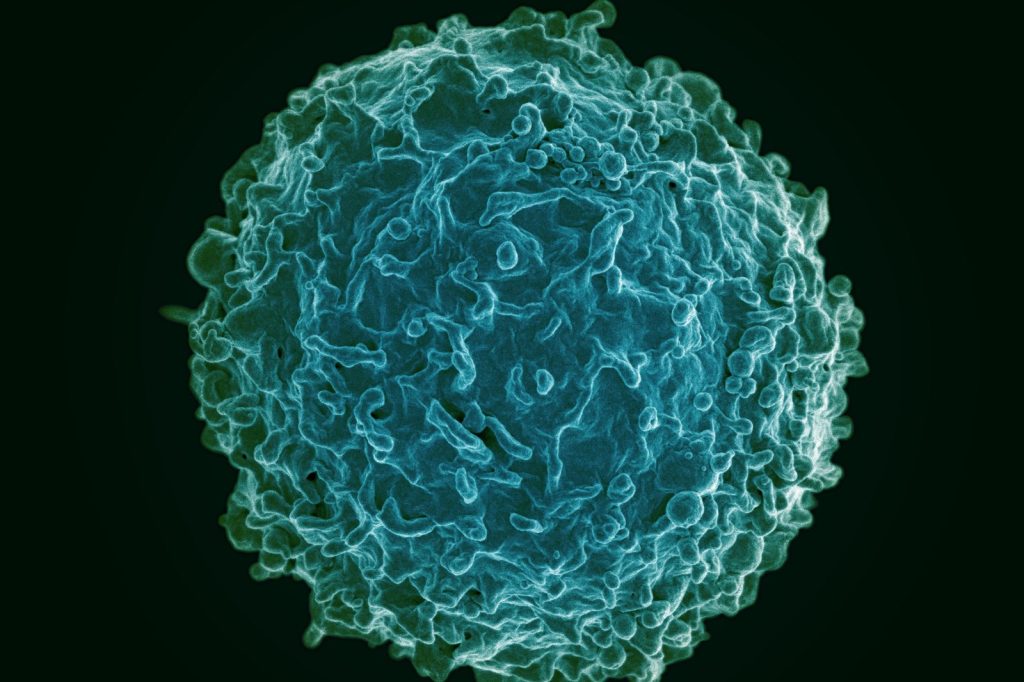
B cells and T cells, both lymphocytes, do the main work. B cells secrete antibodies, also called immunoglobulins. These proteins travel in the blood, bind to a foreign antigen and stop it attaching to the host. T cells handle the cell-mediated side of the response.
Both start from the same stem cells in the bone marrow, and they look identical until they are activated. T cell precursors then move to the thymus to develop. B cells mature in the marrow, going through stages from pro-B and pre-B cells to mature cells carrying a working receptor.
The body holds about 2 trillion lymphocytes, 20 to 40 percent of its white blood cells. Their combined mass is about that of the brain or the liver. Only 2 percent are in the bloodstream at any moment. The rest move through tissues and the lymphatic system, including the lymph nodes and spleen. Each hour, roughly 1 to 2 percent of the pool recirculates, which gives the cells more chances to run into the antigen they match.
How a threat gets noticed
Dendritic cells act as scouts. They engulf bacteria, parasites or toxins in the tissues, chop them into fragments and carry those to the lymph nodes. There they display the fragments on a receptor called the major histocompatibility complex, or MHC. T cells passing through check what is on show.
The type of MHC decides who responds. Fragments from outside invaders usually sit on MHC class II molecules and activate CD4+ helper T cells. Fragments from viruses or bacteria replicating inside a host cell sit on MHC class I and activate CD8+ cytotoxic T cells. These killer cells cause infected or damaged cells to die. Once activated, a cytotoxic cell divides rapidly into an army of effector cells, then searches the body for its target. Because the damage can be extensive, activation is tightly controlled and normally needs a very strong signal.
It is not quick. In humans the adaptive system needs 4 to 7 days to mount a significant response to a new germ. Afterwards it keeps naive cells in reserve, effector cells for active fights, and memory cells that survived past infections.
Why the system adapts
Two mechanisms create the variety. Somatic hypermutation speeds up random mutations in antibody genes. V(D)J recombination picks one variable, one diversity and one joining segment at random and discards the rest, so each lymphocyte ends up with a unique receptor. The change is permanent in the cell’s DNA, so its descendants, memory cells included, carry the same specificity.
The same machinery can misfire. When the system cannot tell harmful from harmless, the result is hay fever, asthma or another allergy. When it targets the body’s own tissue, the result can be autoimmune disease, such as rheumatoid arthritis, which brings chronic joint inflammation, or type 1 diabetes, in which insulin-producing cells in the pancreas are destroyed. A failure in the other direction is immunodeficiency. Severe combined immunodeficiency is a genetic lack of both B and T cells, and HIV attacks CD4+ T cells.
Newer treatments build on this biology. CAR-T therapy engineers a patient’s T cells to carry receptors aimed at cancer cells. mRNA vaccines instruct cells to produce an antigen so the immune system learns to recognise it, a technology used in COVID-19 vaccines. Consult your doctor for medical advice.
Sources
- Adaptive immune system – Wikipedia
- Adaptive Immunity: T-Cells, B-Cells, and Immune Responses – THE SCIENCE NOTES




