
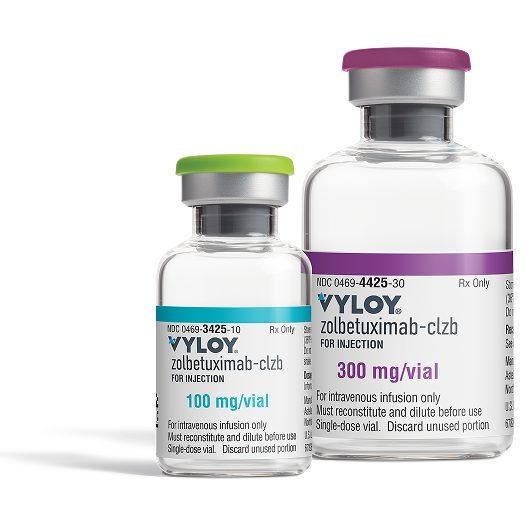
Nearly 44,000 people in Japan died of gastric cancer in 2022, according to Kohei Shitara, MD, who heads gastrointestinal oncology at the National Cancer Center Hospital East in Kashiwa. On March 26, 2024, Japan’s Ministry of Health, Labour and Welfare (MHLW) approved a new drug aimed at that disease: zolbetuximab, sold as Vyloy.
The approval covers patients with CLDN18.2-positive, HER2-negative gastric cancer that cannot be removed by surgery and is advanced or has returned, used together with chemotherapy. Astellas Pharma, the maker, and OncLive both describe Vyloy as the first and only CLDN18.2-targeted therapy approved by any regulator anywhere.
The trials behind it
Two phase 3 studies supported the decision. SPOTLIGHT paired zolbetuximab with mFOLFOX6 chemotherapy; 279 patients got the drug and 278 got placebo. GLOW paired it with CAPOX; 254 got the drug and 253 got placebo. All were previously untreated.
Both met their main goal, progression-free survival. In SPOTLIGHT the median was 10.61 months with zolbetuximab against 8.67 months for placebo. In GLOW it was 8.21 months against 6.80 months. Overall survival also improved: 18.23 months against 15.54 months in SPOTLIGHT, and 14.39 months against 12.16 months in GLOW.
Shitara, the lead investigator on SPOTLIGHT, said he saw “significant improvement” in both progression-free and overall survival firsthand. “Developing new targeted therapies is critical for diseases like advanced gastric adenocarcinoma, which has had very limited treatment options and is often discovered at an advanced stage,” he said.
Nausea, vomiting and decreased appetite were the most common side effects in both trials. In SPOTLIGHT, nausea hit 82% of patients on zolbetuximab and 61% in the control arm; vomiting affected 67% on the drug. Astellas said doctors managed these with antiemetics, dose interruptions and infusion rate adjustments.
Testing decides who qualifies
Only some tumors carry the target. Around 38% of patients screened in the two trials were CLDN18.2-positive, defined as 75% or more of tumor cells showing moderate-to-strong staining. A pathologist has to confirm that with an approved test. Astellas developed one with Roche Diagnostics, the VENTANA CLDN18 (43-14A) RxDx Assay, and testing will be offered at multiple central laboratories in Japan, with more to be added over time.
Pharmaphorum noted that testing is not yet routine, which is why sales estimates are modest. GlobalData predicts roughly $750 million by 2030, though some analysts say it could top $1 billion if a third of eligible patients receive it.
Origins and the US setback
Astellas acquired zolbetuximab by taking over Ganymed Pharma in 2016, paying around $430 million upfront in a deal worth up to $1.3 billion in total. The Japanese decision came a few weeks after the US Food and Drug Administration turned down Astellas’ application there, citing “unresolved deficiencies” found when it inspected a third-party manufacturing facility for the antibody. Astellas has submitted applications to regulators worldwide, and those reviews are continuing.
Gastric cancer is the third deadliest cancer in Japan, with 126,724 cases diagnosed in 2022. Moitreyee Chatterjee-Kishore, an Astellas senior vice president, said the approval “marks a new era in the treatment of gastric cancer.” Patients should talk to their doctor about whether a targeted therapy suits them.
Sources
- Japan’s MHLW Approves Zolbetuximab in CLDN18.2-Positive Gastric Cancer | OncLive
- MHLW (Japan) approval for Vyloy (zolbetuximab) to treat CLDN18.2 positive, unresectable, advanced or recurrent gastric cancer. Astellas
- Japan clears first CLDN18.2 drug, Astellas’ Vyloy




