
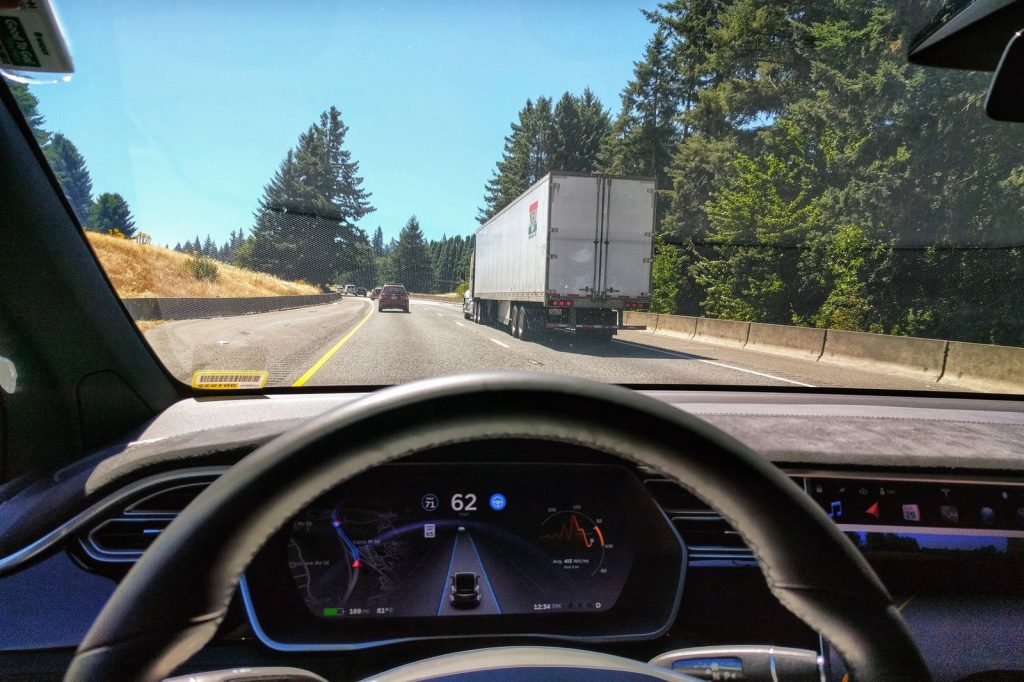
Eleven crashes, 17 injuries, one death. That is the tally US auto safety regulators cited on Monday when they opened a formal safety probe into Tesla’s Autopilot driver assistance system.
The National Highway Traffic Safety Administration (NHTSA) said the 11 crashes, spread since January 2018, share a pattern: Teslas “have encountered first responder scenes and subsequently struck one or more vehicles involved with those scenes.” The death came in December 2019, when a Model 3 hit a parked fire truck in Indiana and a passenger was killed. Every car involved was confirmed to have been using either Autopilot or Traffic Aware Cruise Control.
Most of the crashes happened after dark. The scenes had emergency vehicle lights, flares or road cones, and in some cases illuminated arrow boards.
What the probe covers
The inquiry takes in an estimated 765,000 US vehicles with Autopilot, built since 2014. That means Models S, X, 3 and Y built between 2014 and 2021. NHTSA said it will look at the “technologies and methods used to monitor, assist and enforce the driver’s engagement with the dynamic driving task during Autopilot operation.” It will also examine how the system detects objects and events, and where it is allowed to operate.
The agency can close the case with no action, or it can demand a recall. A recall might effectively limit how, when and where Autopilot works, and any restrictions could narrow the competitive gap between Tesla and similar systems from established carmakers. Before NHTSA could order one, though, it must first upgrade the probe to an engineering analysis.
Reaction
NTSB chair Jennifer Homendy praised the new probe. Her board has urged NHTSA to develop standards for driver monitoring systems and to require automakers to “incorporate system safeguards that limit the use of automated vehicle control systems to those conditions for which they were designed.” The NTSB has said Autopilot was on in at least three fatal Tesla crashes in the US since 2016, and it criticised Tesla’s lack of safeguards and NHTSA’s failure to ensure Autopilot’s safety.
Bryant Walker Smith, a University of South Carolina law professor, said the crashes with parked emergency vehicles “illustrate in vivid and even tragic fashion some of the key concerns with Tesla’s system.” Democratic Senators Richard Blumenthal and Ed Markey asked for a thorough, transparent probe.
The problem was known inside Tesla. In February last year, Andrej Karpathy, the company’s director of autonomous driving technology, named one challenge for Autopilot: recognising when a parked police car’s flashing lights are on.
Tesla has said repeatedly that Autopilot is a driver aid, not self-driving technology. In emails to the California DMV, it acknowledged the system offers no more than level 2 autonomy, which is driver-supervised highway assistance. NHTSA’s statement was blunt: “no commercially available motor vehicles today are capable of driving themselves.”
Separately, NHTSA has sent teams to review 31 Tesla crashes involving 10 deaths since 2016 where it suspected advanced driver assistance systems were in use. It ruled out Autopilot in three of them.
Sources
- US to probe Tesla's Autopilot after series of crashes
- US government launches probe into Tesla Autopilot after emergency vehicle crashes




