
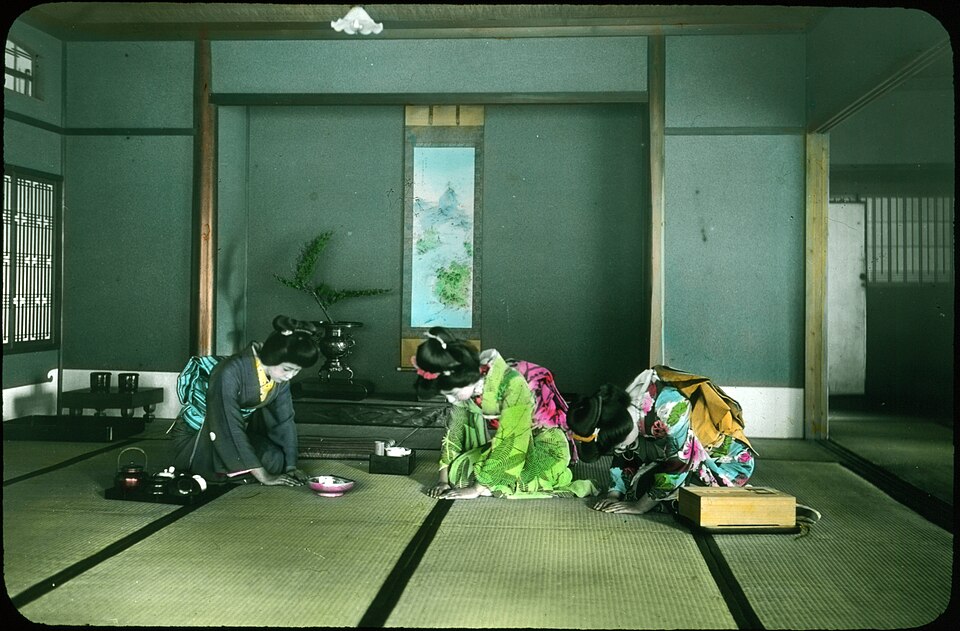
The doorway is low on purpose. According to the Urasenke school, as cited by e-Buddhism.com, the tea master Sen no Rikyū built such entrances so that every guest “had to crawl” in “regardless of rank.” Inside the room, everything is small, plain and deliberate.
This is chanoyu, also called chado, “the Way of Tea.” The name means, very plainly, “hot water for tea.” A gathering can run for hours. The host wipes down the utensils, folds a silk cloth with a precise routine, sets the bowl, measures the matcha, adds hot water and whisks until the surface turns bright green. A calligraphy scroll and one seasonal bloom set the tone. Sweets may arrive first, to offset the bitterness.
A cup for the emperor
The earliest firm record dates to 815. Eichu, a monk newly back from Tang China, prepared tea for Emperor Saga at Bonshaku-ji, a temple beside Lake Biwa. The court chronicle Nihon Koki says the emperor was impressed enough to commission plantings across several provinces, Yamato and Harima among them.
It did not take root. The tea of that era was cake tea in the Tang manner rather than matcha, and it circulated only among temples and the aristocracy. In 894 official missions to China came to an end, and with them a main channel for tea techniques. Then came 1191, when the monk Eisai returned from Song China with powdered tea, the root of later matcha culture. That is a gap of about 376 years after Eichu.
Zen monks wove tea into monastic life next. Encyclopaedia Britannica, quoted by e-Buddhism.com, says they drank it “to keep awake during long sessions of meditation.” Eisai championed it with aristocrats, senior samurai and monks. By the 1300s ordinary people outside those circles drank it too. Not everything was solemn. Guests played “tea gambling,” guessing which cups held tea from Toganoo.
Rikyū and the four principles
Rikyū, who lived from 1522 to 1591, was not the founder. Britannica gives that title to Murata Jukō, a monk of the fifteenth century, and says Rikyū perfected the ceremony and lifted it to an art. His own teacher, the merchant Takeno Jōō, put wabi at the heart of the grass-hut style. The word is often rendered “rustic,” though the Asian Art Museum reads it more broadly. Rikyū took the idea to extremes: little space, little light, familiar everyday utensils, and Raku bowls made with the potter Chōjirō that had beauty without show.
He served two warlords in turn, Oda Nobunaga and Toyotomi Hideyoshi. Hideyoshi eventually ordered him to take his own life, and in 1591 he did. Three schools survive from his line: Omotesenke, Urasenke and Mushakōjisenke.
Urasenke says Rikyū condensed the Way of Tea into four ideals: wa, kei, sei and jaku. Wa is harmony among guests, host, utensils and season. Kei is respect, shown in greetings and in how each object is touched. Sei is purity, of the room and of the mind. Jaku is tranquillity, the stillness that settles once the first three are in place.
One phrase sums up the rest: ichigo ichie, “one time, one meeting.” This gathering will never be repeated, so it asks for your complete attention. The Hikone Castle Museum links the idea to a booklet by the tea master Ii Naosuke, completed around 1857.
Sources
- The Japanese Tea Ceremony and Zen (e-Buddhism.com, Tim Yu, updated 29 October 2026)
- e-Buddhism.com, same article, ceremony and history
- e-Buddhism.com, same article, wabi-sabi
- Japanese Tea in the Nara and Heian Periods (Far East Tea Company)




