
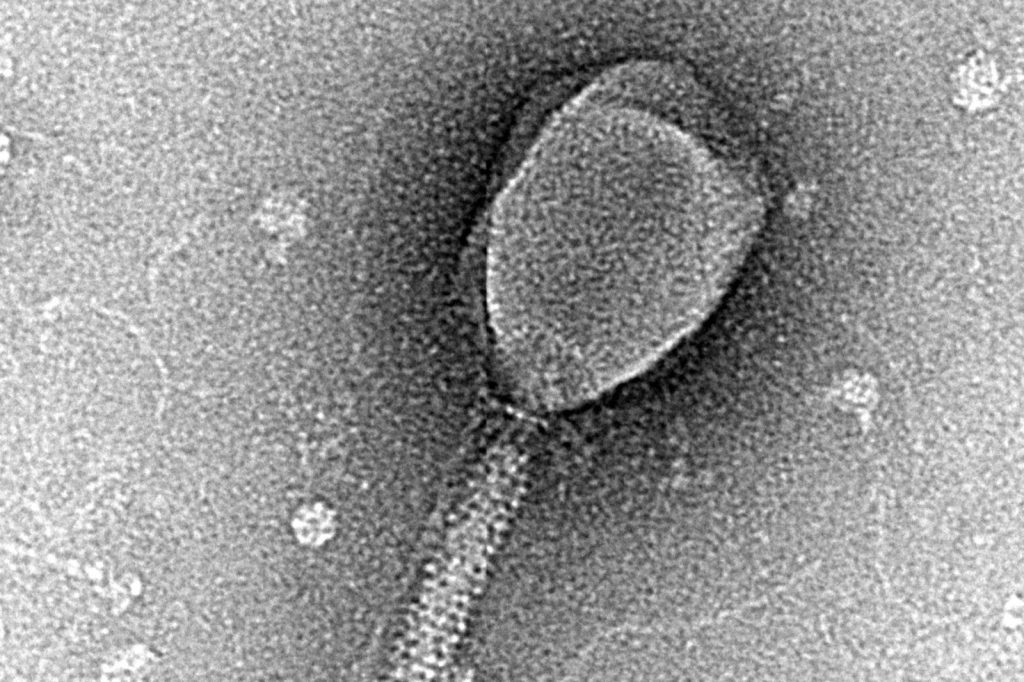
The drug that put a bacteriophage to work did not start as a drug at all. In 1985, George P. Smith, then a biologist, worked out how to use a virus that infects bacteria to evolve new proteins. He called the approach phage display. It earned him a share of the 2018 Nobel Prize in Chemistry, awarded “for the phage display of peptides and antibodies.”
How the method works
Under the hood, the trick is simple to describe. Researchers insert a collection of DNA sequences into bacteriophages. As the phages replicate, each one shows the encoded peptide or protein chain on its surface. Pick out the phages that have a wanted trait, such as sticking to a particular compound, and you automatically recover the DNA that confers it. Mutate that DNA, select again, and the product improves with each round. It is evolution run in a test tube, with the experimenter acting as the environment.
From peptides to antibodies
Smith’s work was on peptides. Sir Gregory Winter pushed it further. “We wondered about using this powerful technique to look at folded proteins, in particular to screen our repertoire of antibodies,” he said, “and it proved to be a great technology.” The Nobel citation credits him with using phage display to steer the evolution of antibodies toward new pharmaceuticals.
The first drug made this way, adalimumab, was approved in 2002. It is prescribed for psoriasis, rheumatoid arthritis and inflammatory bowel disease. Winter co-founded Cambridge Antibody Technology, which developed adalimumab, sold as Humira. The Academy said antibodies from the method have since neutralised toxins, countered autoimmune disease and, in some cases, cured metastatic cancer. Nordic Life Science adds two more drugs to the list: Benlysta, for lupus, and Portrazza, for cancer.
The decision not to patent
Smith has said that leaving phage display unpatented was critical to how widely it spread. “I could talk about it and give samples to anyone in industry or academia,” he said. “I doubt I’d have received a Nobel Prize if I’d been pursuing intellectual property protection instead.”
Patents have their reasons, he said, but they can also hem in creativity. “Ideas are not your property.”
The 2018 chemistry prize was split. One half went to Frances H. Arnold of Caltech for the directed evolution of enzymes. The other half was shared by Smith, of the University of Missouri, and Winter, of the MRC Laboratory of Molecular Biology in Cambridge. The prize amount was 9 million Swedish krona. Smith retired from the university in 2015.
Sources
- Press release: The Nobel Prize in Chemistry 2018 (NobelPrize.org)
- George P. Smith and Sir Gregory Winter: From academia to pharma (Nordic Life Science)




