In 2005 a 35-year-old man walked into a cardiology appointment and walked out with a thyroid problem nobody had been looking for. His cardiologist felt something odd in his neck and ordered an ultrasound. Twenty years on, that scan anchors a case report in CA: A Cancer Journal for Clinicians, written by specialists in endocrinology, surgery, oncology, genetics and radiation medicine.
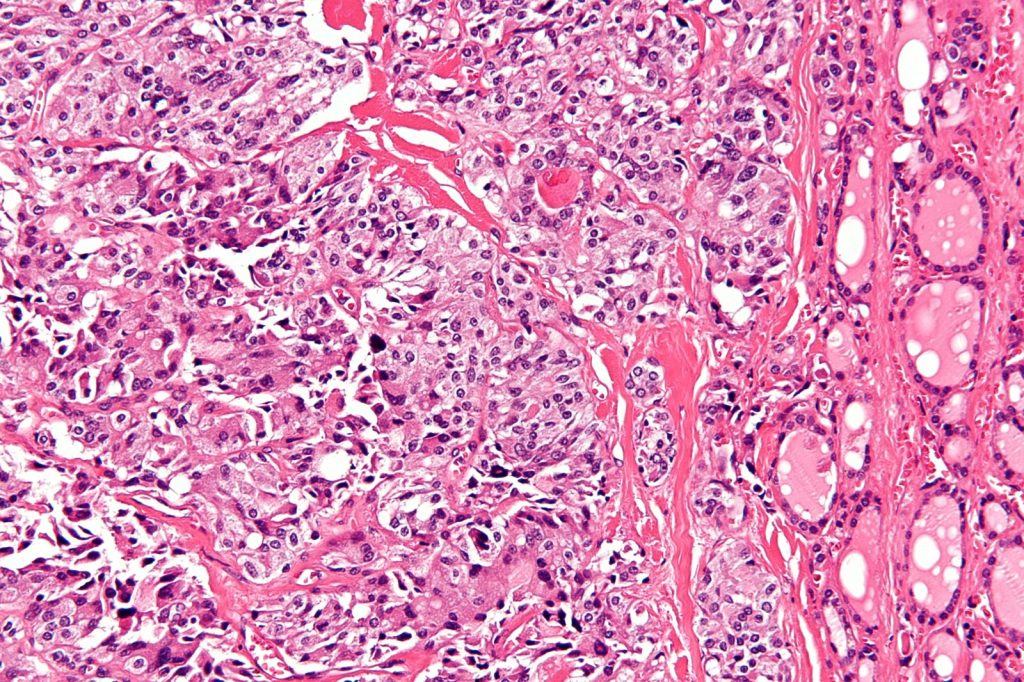
The needle biopsy had pointed to papillary thyroid carcinoma, the common and usually manageable kind. Surgery said otherwise. The tissue was medullary thyroid carcinoma, present in several spots on both sides of the gland, and his calcitonin stood at 1,160 picograms per milliliter against a reference ceiling of 9.8. Calcitonin is the hormone made by the cells where this cancer starts.
What makes this cancer different
Medullary thyroid carcinoma grows from a different cell type, and it ignores the radioactive iodine used against other thyroid cancers. In as many as one case in four it is inherited. Before genetic testing, families usually learned about the hereditary form only after cancer had already turned up: a nodule, a climbing calcitonin level, a relative with a history.
His surgeons took out the thyroid and the central neck lymph nodes. All 19 nodes were clear. Then the RET gene result came back, showing a mutation at codon 609, tied to multiple endocrine neoplasia type 2A. One man’s cancer had become a family problem.
Three generations, two outcomes
A genetic counselor ran cascade testing through the relatives and found more carriers, including his brother, son and daughter.
The brother was not screened until he was 37. By then the disease had spread. His calcitonin before surgery was 2,450 picograms per milliliter, he had a total thyroidectomy with neck dissection on both sides, and he still has disease. He is on selpercatinib.
The children were caught by the test alone. They had their thyroids removed at 6 and 3. They are now 25 and 22, with undetectable calcitonin ever since and no sign of cancer. The patient’s own account in the report says that learning his children carried the mutation was overwhelming and painful at first, and that the clarity testing gave him soon turned fear into direction.
Twenty years of follow-up
After his own operation, the father’s calcitonin dropped to undetectable and stayed there for three years. It began rising in 2008. By 2013, imaging showed several liver metastases. The disease moved slowly even then: calcitonin went from 850 to 1,820 between 2013 and 2025, roughly 80 picograms per milliliter a year. Doubling time, the figure doctors use to judge how fast the tumor is moving, lengthened from about 13 months early on to over 24 months at the time of the liver findings, and past 60 months afterward.
He had no symptoms, so his team watched rather than treated by the numbers. In 2025, FDG-PET-CT picked up new hypermetabolic lesions and MRI confirmed metastases in the spine. No pain, no pressure on the spinal cord. Surveillance continues, with a bisphosphonate for the bone involvement. Radiation, the team decided, stays in reserve.
The drugs
Older treatment for advanced disease used drugs that hit several signaling pathways at once. They slowed the cancer and brought high blood pressure, severe diarrhea, fatigue and skin problems on the hands and feet. Plenty of patients had their doses cut or came off them.
Newer drugs block RET alone. In the LIBRETTO-001 and ARROW trials, which the paper cites, response rates ran from 69% to 79% in patients with RET-mutated disease, with far fewer side effects. Response was similar whether the mutation was inherited or acquired by the tumor. About half of sporadic cases carry a somatic RET mutation, so those tumors have to be tested directly.
The report also cites screening data. In a German cohort, average age at diagnosis fell from 35.6 to 23.0 years once routine screening began. In a Norwegian study, remission rose from 50% to 89% after systematic genetic testing was introduced.
The patient argues that molecular testing should not depend on luck, geography or money, and wants public agencies to make it more widely available to families with a known history.
The authors are plain about the limits. This is one family, not a trial, and the findings cannot be generalized to every patient. Evidence for adjuvant radiation in this cancer rests on small retrospective studies, and circulating tumor DNA is described as promising but has no established decision thresholds. Anyone weighing genetic testing or treatment should talk to a doctor.