
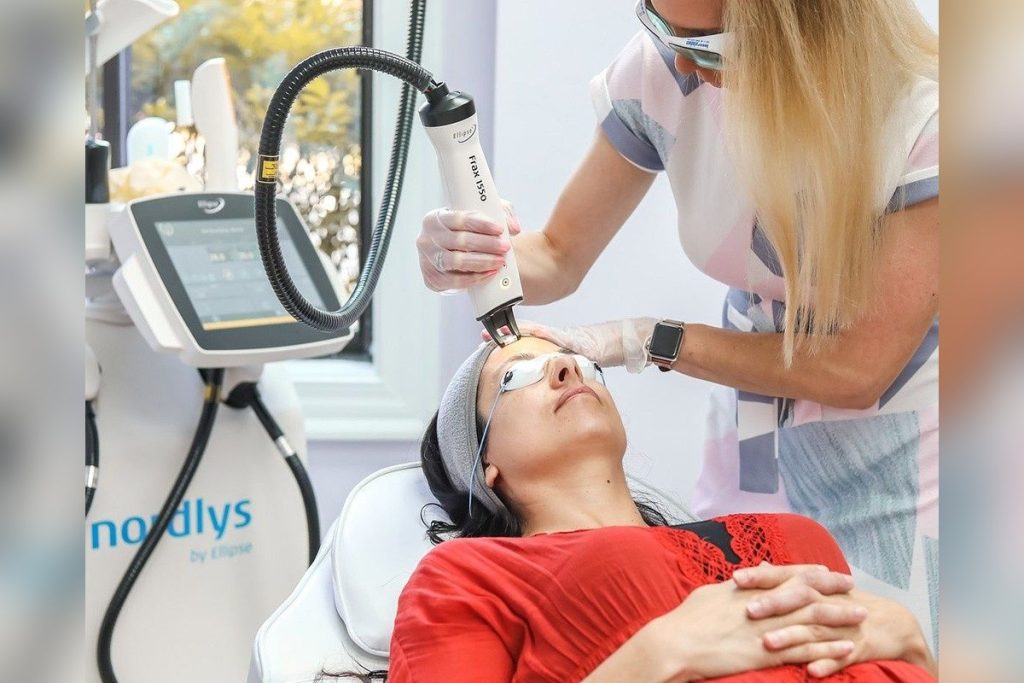
Twenty-two adults, three laser sessions, one half of each face left untouched. That was the design of a study Candela Corporation announced on June 30, 2026, and the company says the results show its Nordlys laser changes the biology of aging skin, not only its look.
The paper appeared in Scientific Reports, part of the Nature Portfolio. It was done with Mitra Bio and the Candela Institute for Excellence, the company’s research and education arm. The authors describe it as the first in vivo human evidence that the Nordlys 1940 nm non-ablative fractional laser alters the skin’s epigenetic profile.
What the researchers measured
Instead of judging results by photographs alone, the team looked at DNA methylation. These are chemical tags on DNA that help control how genes behave without altering the genetic code, and scientists increasingly use them to estimate biological age.
The team profiled more than 3.8 million sites in the genome per sample over nine months. At 83.9 percent of the sites most strongly tied to skin aging, the treatment pushed methylation in the opposite direction from normal aging.
The effect took time. Nothing showed up right after treatment. About a month after the series ended, 635 differentially methylated regions had emerged. They grew through month three and were still present, and stabilizing, at six months.
Visible changes
Skin imaging with the VISIA system picked up changes people could see. Brown-spot counts on the treated side of the face fell by a median of 38 percent one month after the series, significantly more than on the untreated side. Texture and overall pigmentation also improved. The genes involved are linked to collagen regeneration and organization, skin barrier integrity and the specialization of skin cells.
The skin cancer signal
The researchers also found methylation changes at genes tied to basal and squamous cell skin cancers, among them FGFR3, HOXB4, UBE2I and PPP1R18/PPP1R26. The study was not built to measure cancer prevention. The authors say the pattern fits earlier clinical research, published in 2023 in Dermatologic Surgery, that linked non-ablative fractional laser treatment to a lower risk of later facial keratinocyte carcinoma.
That is not a claim that the laser prevents cancer, and Longevity.Technology, which covered the study, noted that larger trials will be needed to confirm the results.
What the authors said
“This study is an important first step toward understanding the biology beneath what we observe in the clinic,” said Dr. Konika Patel Schallen, the lead author and Candela’s senior vice president of global clinical operations. “Physicians have seen that Nordlys treatments do more than improve the skin’s appearance and until now, we could not fully explain why.”
Dr. Cristiana Banila, chief scientific officer and co-founder of Mitra Bio, was a co-author. “The changes were not only directional, opposing the patterns we associate with aging, but also durable and strengthening over months,” she said. “That combination is what makes these results scientifically compelling.”
Candela chief executive Geoff Crouse said the company wants to lead “beyond the cosmetic realm and into regenerative medicine, skin health, and longevity.” The company, which Apax Partners acquired in July 2017, sells in 86 countries. Anyone considering laser treatment should talk to their doctor.
Sources
- Laser treatment found to reverse skin aging markers
- New Human Study in Nature's Scientific Reports Finds Candela's Nordlys® Non-Ablative Fractional Laser Reverses the Skin's Epigenetic Signature of Aging




