
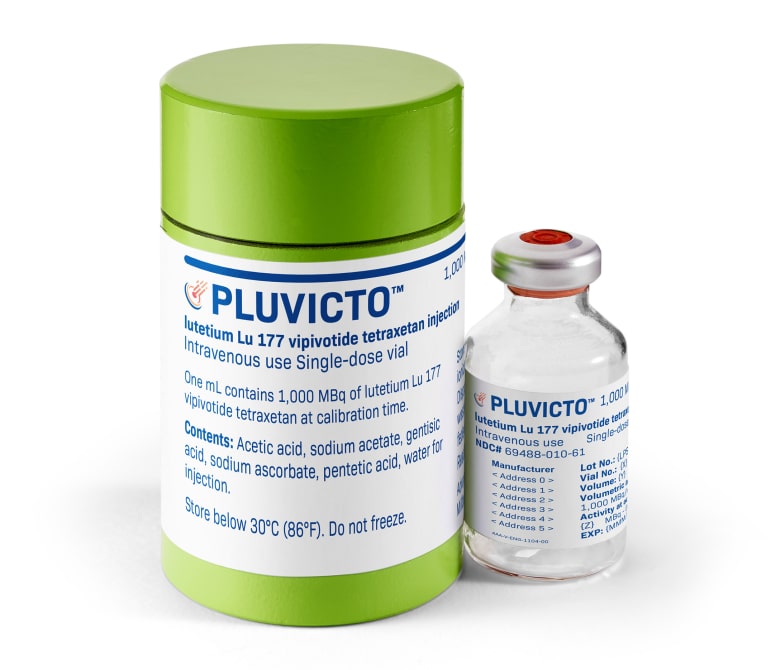
The shift in prostate cancer care is that the drug now travels to the tumor. On March 23, 2022, Novartis announced that the FDA had cleared Pluvicto, the first targeted radioligand therapy for men with advanced PSMA-positive prostate cancer that has spread and no longer responds to hormone-lowering treatment (mCRPC). Earlier in development it went by 177Lu-PSMA-617.
It is for patients who have already run through the usual options: treatment that blocks the androgen receptor pathway and taxane-based chemotherapy. Novartis noted that metastatic prostate cancer carries a five-year survival rate of less than 30%.
How it works
Pluvicto pairs two parts. One is a ligand that locks onto PSMA, a protein that sits on the outside of prostate cancer cells. The other is a radioactive particle, lutetium-177. After the infusion, the drug attaches to PSMA and the radiation kills the tumor cell it is stuck to, with little effect on neighbouring cells, the European Medicines Agency says. Novartis says the marker turns up heavily in a share of patients greater than 80 percent, which makes it a handy target.
Finding the right patients is part of the package. The FDA approved a companion imaging agent, Locametz, at the same time. Once labelled with gallium-68, it lights up PSMA-positive lesions on a PET scan and maps the spread, whether it has reached bone, lymph nodes or other soft tissue.
What the trials showed
The approval rested on the Phase III VISION trial. Men who got Pluvicto plus standard of care had a 38% lower risk of death than those on standard care alone, and a statistically significant drop in the risk of radiographic progression or death. Novartis cautioned that the size of that second effect is hard to read, because many patients in the control arm dropped out early. About a third of evaluable patients, 30%, saw their tumors respond, against 2% on standard care.
The European regulator describes a main study of 831 patients, 551 on Pluvicto and 280 on standard care only. Progression-free time averaged 8.7 months on Pluvicto, versus 3.4 months. Average overall survival was 15.3 months, versus 11.3 months.
It is not gentle. Fatigue hit 43% of patients on Pluvicto and dry mouth 39%. Then came nausea at 35%, anemia at 32%, poorer appetite at 21% and constipation at 20%. The drug gives off radioactivity, so only qualified staff in controlled areas may give it, by drip, one dose every 6 weeks, to a maximum of 6.
Europe followed
Pluvicto received a marketing authorisation valid across the EU on 09 December 2022. Novartis said it was running two Phase III studies in earlier lines of treatment for metastatic prostate cancer. Watch this space: the aim is to move radioligand therapy up the treatment line.
Sources
- Novartis Pluvicto approved by FDA as first targeted radioligand therapy for PSMA-positive mCRPC
- Pluvicto (European Medicines Agency)




