
In a laboratory at Florida Atlantic University, a mannequin head sits attached to a fog machine, and a green laser sheet hangs in the air in front of it. When the pump fires, green vapour jets out of the mannequin’s mouth and glows. It is a simulated cough, and the researchers behind it wanted to see what a mask does to it.
The experiment, reported in Physics of Fluids on June 30, 2020, was led by Siddhartha Verma, an assistant professor in the university’s College of Engineering and Computer Science, with Manhar R. Dhanak and John Frankenfield. The fog machine made vapour from water and glycerin. The laser sheet came from a green laser pointer shone through a cylindrical rod, a staple of fluid mechanics that Verma likens to seeing dust in a beam of sunlight.
Four coverings, one bare face
With nothing over the mannequin’s face, the simulated cough travelled up to 12 feet in 50 seconds. That is well past the 6 feet most social distancing guidelines cite.
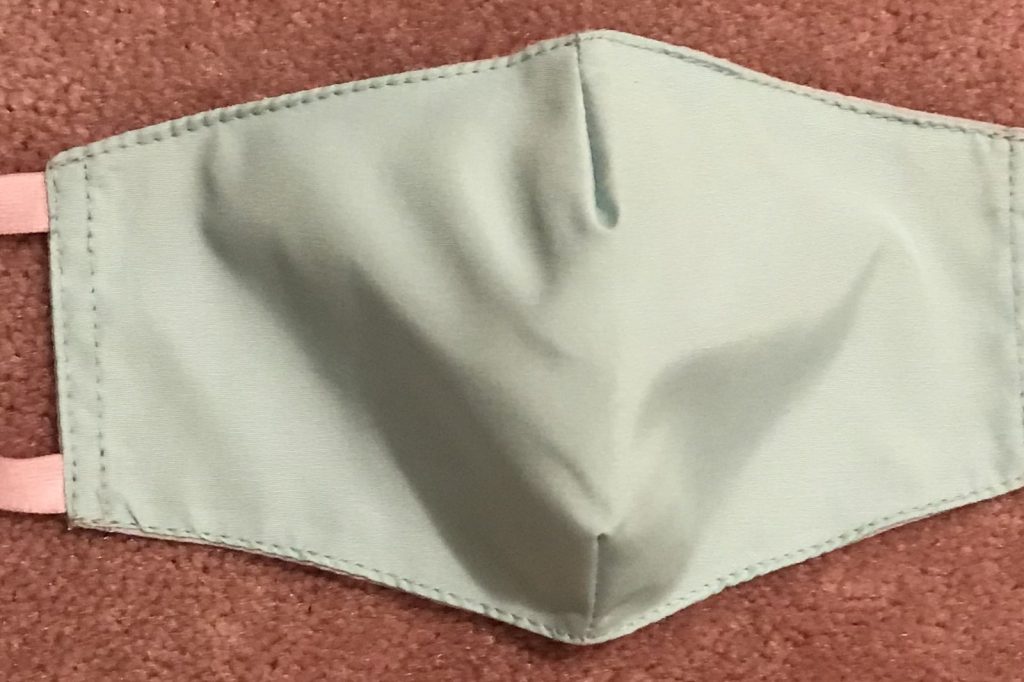
The team then tried four non-medical masks. One was a homemade design stitched from two layers of quilting cotton, 70 threads to the inch. The others were a single-layer bandana, a loosely folded cotton handkerchief and a non-sterile cone-style mask of the kind sold in pharmacies. The loosely folded mask and the bandana cut the distance the droplet jets reached to between 1/8 and 1/2 of the uncovered figure.
The two-layer cotton mask did best. Droplets moved only about 2.5 inches (6.35 centimeters) forward, though some leaked out at the top, where the cloth meets the nose. The cone mask held the jet to about 8 inches (20 cm). Both, the university said, reduced droplet numbers significantly despite the leakage.
What the authors caution
Verma did not oversell it. The setup used a simplified cough, “which, in reality, is complex and dynamic,” he said, and the authors noted the need for more quantitative analysis. “While there are a few prior studies on the effectiveness of medical-grade equipment, we don’t have a lot of information about the cloth-based coverings that are most accessible to us at present,” he said.
Nor does a mask close the door on infection. “It is also important to understand that face coverings are not a 100% effective in blocking respiratory pathogens,” Verma said. His advice was to combine social distancing, face coverings and hand-washing until an effective vaccine arrives.
Sources
- News Release (Florida Atlantic University)
- Visualization shows exactly how face masks stop COVID-19 transmission




