
Put $1,000 in a savings account paying 10% and leave it alone. Under simple interest you collect $100 a year, so after 20 years you hold $3,000. You tripled your money. Under compound interest the same deposit does something quite different, and the mechanics here explain why savers are told to start early.
Interest on interest
The first year looks the same: $1,100. The second year is where the paths split. Compounding pays 10% on $1,100, which is $110, giving $1,210. Simple interest would leave you at $1,200. The gap is small at first. The catch is that it never stops widening, because the yearly gain itself keeps growing: $100 in year one, $110 in year two, $379 by year 15. A bank pays you because it can lend your deposit out, and this is the same logic in reverse when you borrow and pay interest yourself.
How often the interest is added matters too, but less than people assume. On $1,000 at 10% for 10 years, moving from annual to quarterly compounding is worth $91. The spread between the most and least frequent schedules is $124. Going from monthly to daily barely registers, and between daily and continuous there is a difference of just $0.37. Quarterly compounding over those 10 years ends at $2,685.
Doing the arithmetic
You can grind it out by hand. Take $1,000 at 5%: multiply by 0.05 for $50, add it for $1,050, then multiply $1,050 by 0.05 for $52.50, and so on to $1,102.50. Slow, but it works.
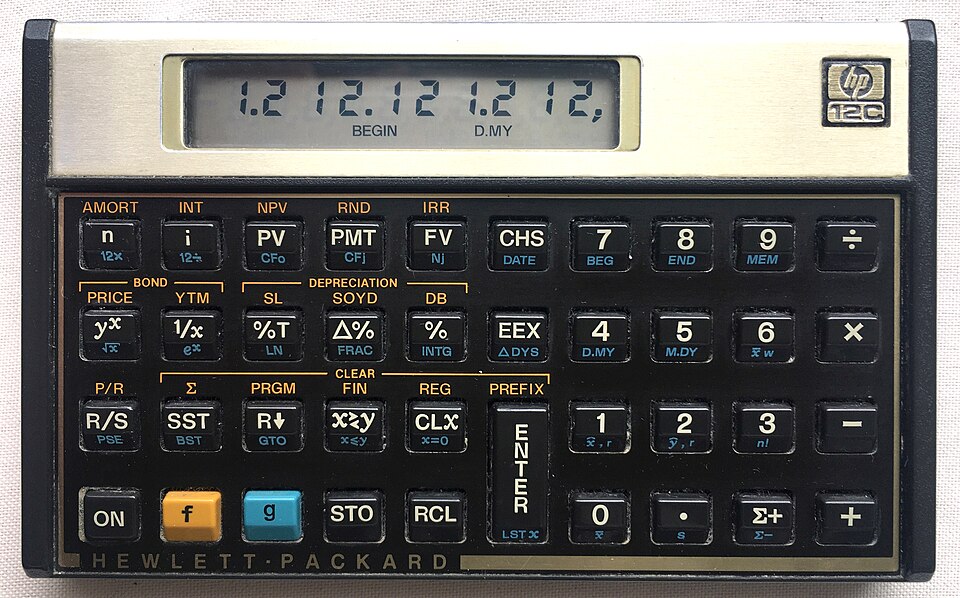
The formula is faster. A = P(1 + r/n)^(nt), where A is the final amount, P the starting principal, r the rate as a decimal, n the number of compoundings per year and t the years. For quarterly compounding over 10 years, n times t gives an exponent of 400 once you set it up as the source does with its 40 periods and a rate of 0.10. Online calculators, including one at Fool.com, do this for you.
A compounding table is handier still. It lists the multiplier for a given rate and period. At 12% for 20 years the multiplier is 9.65, so $5,000 becomes $48,250. Looking for a tripling? Twelve percent for 10 years gives 3.11, and 8% for 15 years gives 3.17. At 25% it takes only five years, though finding that return is a tall order.
Shortcuts and the stock market
For a rough doubling time, divide 72 by the annual rate. At 10% that is about 7.2 years. The rule drifts at high rates: at 72% it predicts one year, yet doubling needs a 100% gain, and even at 25% the true answer is 3.1 years.
Compound annual growth rate runs the arithmetic backwards. Turn $1,000 into $2,000 over 15 years and the CAGR is 4.73% a year. Stocks make it useful, since the market zigzags, up more than 20% or 30% in some years, while the long-term average sits near 10%. A $1,000 stake growing 10% a year would reach around $2,590 after a decade. That is a long-run average, not a promise for any single company or year.




