
Here is a curious thing about Alzheimer’s research: one of the more interesting new results involves an amino acid you can buy over the counter. A team at Kindai University in Osaka reported that arginine, given by mouth, cut the buildup of amyloid-beta in fruit flies and mice engineered to develop Alzheimer’s-like pathology. The study went online in Neurochemistry International on October 30, 2025.
How it works
Amyloid-beta, and especially its 42-amino-acid form, Aβ42, tends to clump into fibrils and then plaques. Arginine seems to act as a chemical chaperone, a molecule that helps proteins keep their shape and avoid misfolding. In a test tube, adding arginine slowed Aβ42 clumping, and more arginine meant less clumping. At 1 mM, lifespan.io reported, the inhibition reached roughly 80%. A green tea compound, EGCG, did better in the dish, but it is poorly absorbed when swallowed and has damaged the liver at therapeutic doses, which is probably why the team did not carry it into animals.
Flies, then mice
The researchers moved to two living models. One was a fruit fly whose eye expressed Aβ42 carrying the Arctic mutation, E22G, a standard neurodegeneration model where toxicity shows up as a shrunken eye. Arginine lowered the share of cells carrying aggregates and eased the toxicity. Expression of the transgene did not change, so the effect lay in aggregation or clearance, not in production.
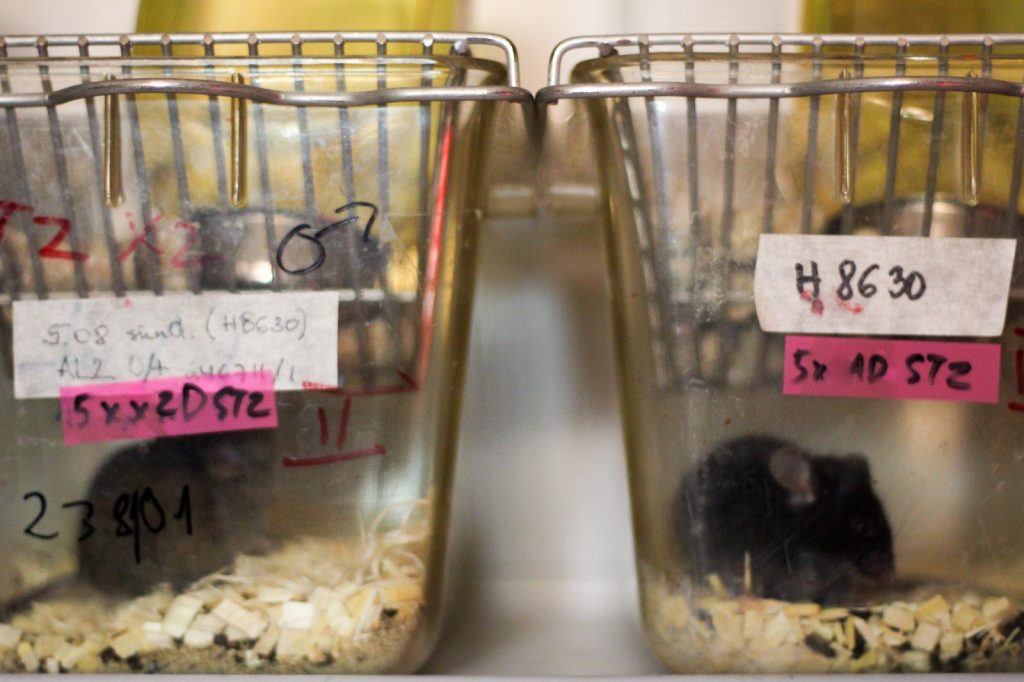
The other was a knock-in mouse, called AppNL-G-F, carrying three familial Alzheimer’s mutations. Treated mice drank water containing 6% arginine from five weeks of age. At six months, plaques in the cortex and hippocampus were clearly smaller and fewer than in controls, and insoluble Aβ42 fell, while soluble Aβ42 stayed put. Treated animals also had fewer dense-core plaques at both six and nine months.
The picture at nine months was less tidy. By then plaque load was close to its ceiling, and the hippocampal effect shrank to a nonsignificant trend. Behavior followed a similar pattern. In the Y-maze, arginine significantly improved results at nine months, but only a weak trend showed at six. The treated mice also expressed fewer pro-inflammatory cytokine genes, which suggests an anti-inflammatory benefit beyond blocking clumps.
The caveats
The team was careful on one point. The dose and schedule were built for research and do not match commercial supplements. Scaled to a person, the mouse dose comes to 940 mg/kg/day, roughly double the top oral dose Japan has approved for urea cycle disorders. So nobody should read this as a reason to start taking pills.
Still, the case for follow-up is plain. “Arginine is already known to be clinically safe and inexpensive,” said Professor Yoshitaka Nagai, who led the work with graduate student Kanako Fujii and associate professor Toshihide Takeuchi, and he sees it as a candidate for repositioning. Antibody drugs that target amyloid exist, but their benefits remain modest, they are costly, and they can cause immune-related side effects. Nagai said arginine “could be rapidly translated to clinical trials for Alzheimer’s and potentially other related disorders.” The work remains confined to animals.
Sources
- Oral arginine reduces amyloid buildup in Alzheimer’s models
- Arginine Reduces Signs of Alzheimer’s in Mice




