Paul Ehrlich tried 605 chemical variations before one of them worked. The German researcher had noticed that dyes stained some bacteria and not others, and he reasoned that a compound built like a dye could also kill the germs it clung to. He started from a drug already used against other diseases and altered it again and again, testing each version on infected rabbits. The winner, aimed at the microbe behind syphilis, was salvarsan, deployed in 1910 and regarded as the first antibiotic.
Mold, bread and a ruined petri dish
People had been reaching for the same idea long before anyone could explain it. Scientists have learned that ancient Egyptian, Greek, Chinese and Roman healers treated wounds with bread mold and certain soils. It was the late 1800s before researchers began to see why that might work.
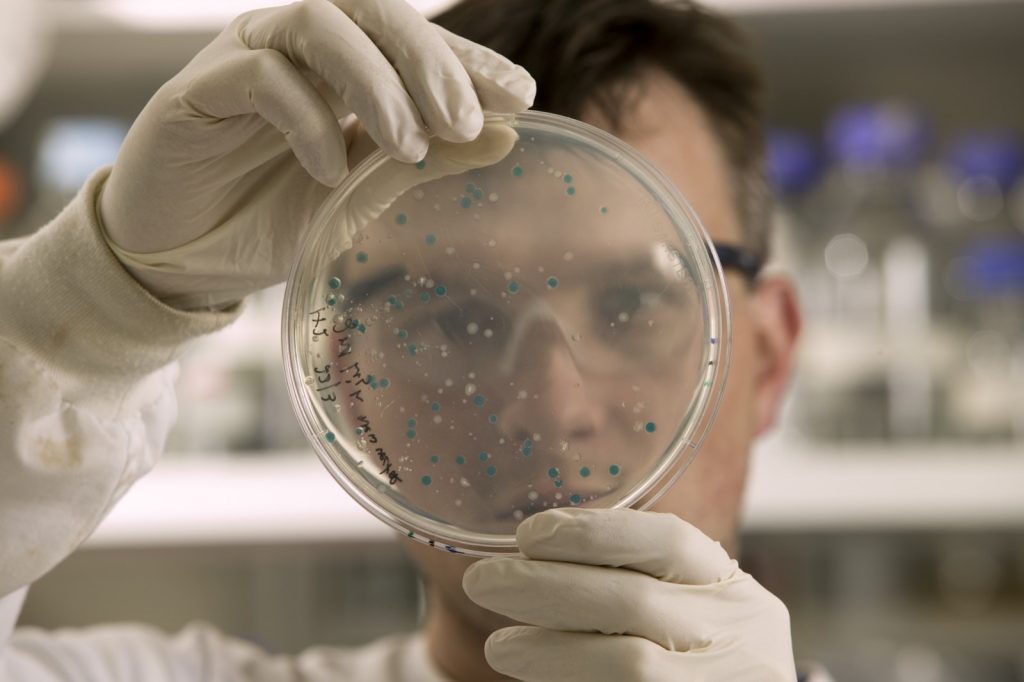
Alexander Fleming, a Scottish biologist, had watched soldiers in World War I die of infected wounds rather than the wounds themselves. Years later he left a dish of bacteria uncovered on his bench and went on holiday. He came back to find bluish-green mold growing in it, and no bacteria near the mold. He is said to have muttered “That’s funny” and gone to find out why. The mold was Penicillium notatum, and the substance it made, which he named penicillin, was the first antibiotic made by a living organism to be extracted and described by a scientist.
Turning that curiosity into a usable drug took roughly another ten years, until chemists managed to extract enough of it. Mass production arrived about when the United States entered World War II, and it saved thousands of lives. A 2019 review in Current Opinion in Microbiology, by Matthew Hutchings, Andrew Truman and Barrie Wilkinson, dates the golden age of natural-product antibiotic discovery to 1928, with the peak in the mid-1950s. In just over a century, the authors write, antibiotics extended average human lifespan by 23 years.
Why the old bottle stops working
Resistance is evolution at small scale. Picture a population of bacteria meeting a powerful antibiotic. Most die. One happens to carry a gene that destroys the drug, so it survives, multiplies, and passes the gene on to every descendant. The infection that returns is a resistant strain, and the same pills no longer touch it.
New resistance genes can arise by mutation, or one bacterium can hand a gene to another in a process called horizontal gene transfer. Bacteria also evolve much faster than drug developers can work, so resistance to a given antibiotic tends to appear soon after the drug does. Arizona State University’s Ask A Biologist project points to MRSA, a resistant form of Staphylococcus aureus, which infects roughly 100,000 people a year in the United States alone. Doctors facing such infections must switch to other drugs, which sometimes work less well or bring bad side effects.
Hutchings and his co-authors trace the present resistance crisis to a gradual decline in antibiotic discovery after the 1950s peak, combined with resistance spreading in many human pathogens.
Reasons for cautious hope
The review is not gloomy about the long run. Its authors argue that genome mining and genome editing could uncover new natural products with varied biological activity. They count 45 drugs going through clinical trials, including several new classes with novel modes of action already in phase 3.
The obstacle they name is money. Changes in financial models, they say, are needed before laboratory advances become approved drugs. Anyone worried about an infection, or about taking antibiotics correctly, should talk to their doctor.