
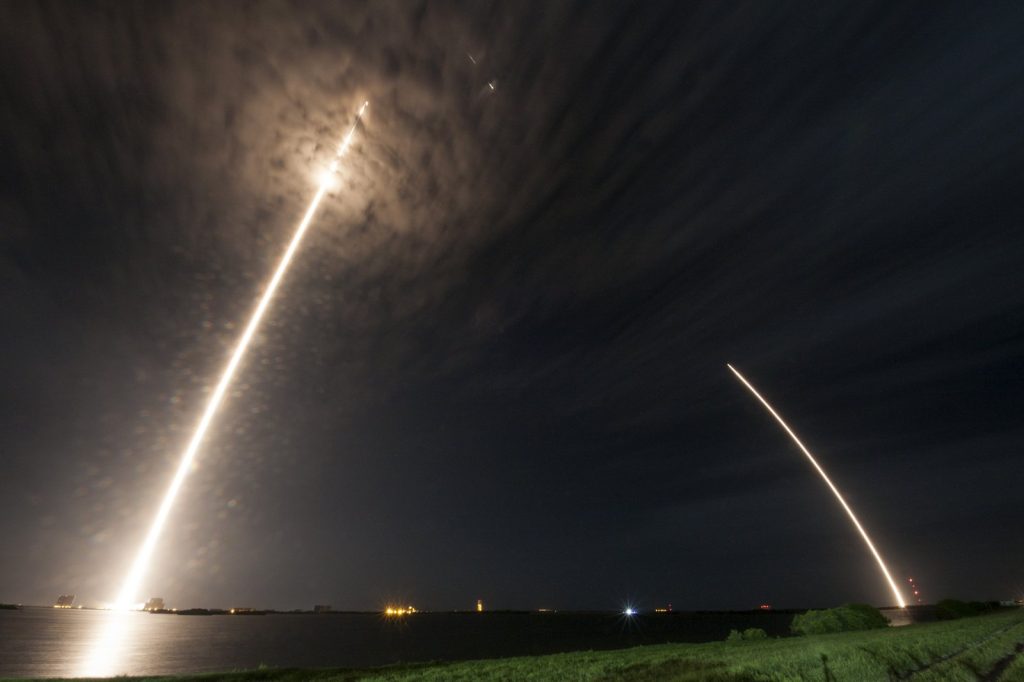
The global launch services market, valued at $12.5 billion in 2023 according to a 2024 report by MarketResearch.com, is experiencing a period of intense competition as companies race to deploy satellite internet constellations. Amazon’s Project Kuiper, which aims to provide broadband coverage from low Earth orbit, has secured launch capacity from multiple providers in a bid to accelerate its deployment. Its primary contracts include United Launch Alliance’s Vulcan Centaur, which first launched in January 2024, and Arianespace’s Ariane 6, which made its debut in July 2024.
Blue Origin’s New Glenn, a heavy-lift rocket announced in 2016 with a reusable first stage, was also expected to join the manifest with its first launch anticipated in 2024. However, in a move that surprised some industry watchers, Amazon contracted with SpaceX in 2023 for three Falcon 9 launches to further speed up Kuiper’s deployment.
This decision drew criticism from Jeff Bezos, Amazon’s founder, who also owns Blue Origin.
A Crowded Launch Market
The Falcon 9 rocket, developed by SpaceX and first launched in June 2010, has now completed over 300 successful launches. Its reusable first stage technology has become a standard for cost-effective access to orbit, making it a sought-after vehicle for a range of customers.
The rocket’s track record stands in contrast to the newer, yet-to-fly New Glenn, which has been in development since 2016 but has not yet launched. SpaceX’s Falcon Heavy, which first flew in February 2018, offers another data point on reusability and heavy lift, capable of carrying up to 63.8 metric tons to low Earth orbit. The competitive landscape underscores the high stakes for companies like Amazon seeking to deploy thousands of satellites.
The decision to purchase Falcon 9 launches, even from a rival, highlights the premium placed on proven hardware when schedules tighten. The Falcon 9’s proven reusability has already changed the economics of spaceflight, and its role in Amazon’s backup plan shows how even competitors turn to reliable hardware when needed.
Falcon 9’s Proven Record vs. New Glenn’s Promise
The Falcon 9 is a partially reusable, two-stage medium-lift launch vehicle built by SpaceX in the United States. Conceived in the mid-2000s, it first reached orbit in 2010 after earlier targets slipped.
The rocket uses a booster that returns to Earth for reuse, with vertical landing of that stage first achieved in late 2015. Fairing halves are also recovered from the sea and reflown. Over time, the vehicle became the most flown of active rockets.
It carries crew to the International Space Station and is certified for national security and NASA complex missions. Several upgraded versions have flown since the original model.
The reusable design lowered barriers to frequent launch, a shift that matters now because satellite operators like Amazon can buy proven capacity instead of waiting on unproven rockets. While Blue Origin’s New Glenn remains a promising heavy-lift vehicle with a reusable first stage, its first launch was anticipated for 2024 but has yet to occur. The Falcon 9, in contrast, has a long track record of reliability and cost-effectiveness, making it an attractive option even for Amazon, whose founder owns a competing rocket company.
Implications for Satellite Internet
For patients and communities in underserved areas who may one day rely on satellite internet for telemedicine and health information, the encouraging part is the growing number of launch options. Early findings from the Kuiper project suggest that competition among providers could drive down costs and speed up deployment.
However, patients should talk to their doctor about realistic timelines for connectivity improvements in their region. The Falcon 9’s proven reusability has already changed the economics of spaceflight, and its role in Amazon’s backup plan shows how even rivals turn to reliable hardware when schedules tighten. As the launch services market continues to expand, the choice of rocket will remain a critical factor for companies building the infrastructure of tomorrow’s internet.
The availability of multiple launch providers, including United Launch Alliance, Arianespace, Blue Origin, and SpaceX, offers Amazon and other satellite operators a range of options to mitigate risk and accelerate their timelines. The competitive dynamics in the launch market are likely to benefit end users by fostering innovation and cost reduction, though realistic timelines for connectivity improvements depend on the pace of satellite deployment and regulatory approvals.




