GSK expects to nearly double the number of cancer medicines it is testing in clinical trials next year, the Wall Street Journal reported on Tuesday, citing an interview with a scientist at the British drugmaker. Behind the plan sits a business problem: the patents on the company’s blockbuster HIV drugs are running out.
Rebuilding a Cancer Pipeline
Hesham Abdullah, GSK’s head of oncology research and development, told the paper that the company’s clinical-stage portfolio of about 15 assets is likely to come close to doubling in 2027. He said GSK could have 19 to 20 late-stage oncology studies running next year, with candidates moved straight from early-stage to late-stage testing to save time. For patients waiting on new options, shorter timelines are the point.
The push is part of CEO Luke Miels’ effort to reassure investors that GSK can get through the HIV patent cliff. In July, the company said it expected more than 20 late-stage studies by the end of 2026, and three of the seven drugs it picked for faster development were cancer medicines. GSK left oncology more than a decade ago and is now rebuilding, with ris-rez and mo-rez at the centre of the strategy. Its oncology segment brought in £1.08 billion ($1.44 billion) in the first half of 2026. GSK did not immediately respond to Reuters’ request for comment.
A caution for families: a drug in a trial is not a drug that works. Later phases can expose side effects or a lack of benefit, and these figures say nothing yet about survival or remission. Anyone weighing new treatment options should talk to a doctor or oncologist.
A Different Win in Hepatitis B
There was good news in another field too. The US Food and Drug Administration approved Hibsago (bepirovirsen) for chronic hepatitis B in adults without cirrhosis who have been on nucleos(t)ide analogue therapy for at least six months, have suppressed viral DNA and have surface antigen levels at or below 3,000 IU/ml. It is a first-in-class antisense oligonucleotide, approved under Priority Review and Breakthrough Therapy Designation, and it is also approved in Japan. GSK licensed it from Ionis and developed it with that company.
Chronic hepatitis B affects about 1.7 million people in the US, and many remain on treatment indefinitely while facing the risk of serious liver complications, as GSK’s Tony Wood noted. For the first time, he said, US patients have the potential to reach a functional cure after a six-month course, with the option of self-administration after the first dose. In the B-Well phase III trials, 233 of 1,220 participants on bepirovirsen (19 percent) reached functional cure, against none of 614 on placebo. In the subgroup with surface antigen at or below 1,000 IU/ml, the rate was 26 percent. Standard care alone typically achieves under 1 percent after a year.
The medicine carries a boxed warning for on-treatment hepatic flares and for a drop in platelet counts that can be life-threatening. The most common side effects in the trials were injection-site redness, local pain and a temporary rise in a liver enzyme. Patients should discuss those risks with their liver specialist before starting.
Sources
- GSK plc
- Hibsago (bepirovirsen) approved in the US for the treatment of chronic hepatitis B (CHB) | GSK US
- GSK to nearly double cancer drugs in trials next year, WSJ reports
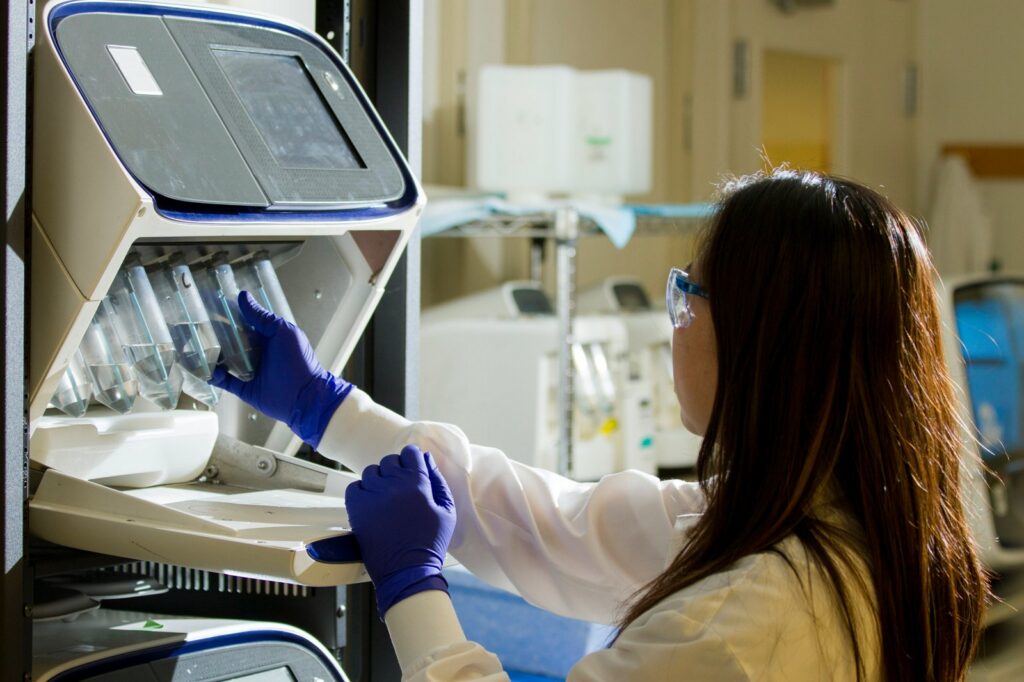
Photo: National Cancer Institute / Unsplash (Unsplash License)