
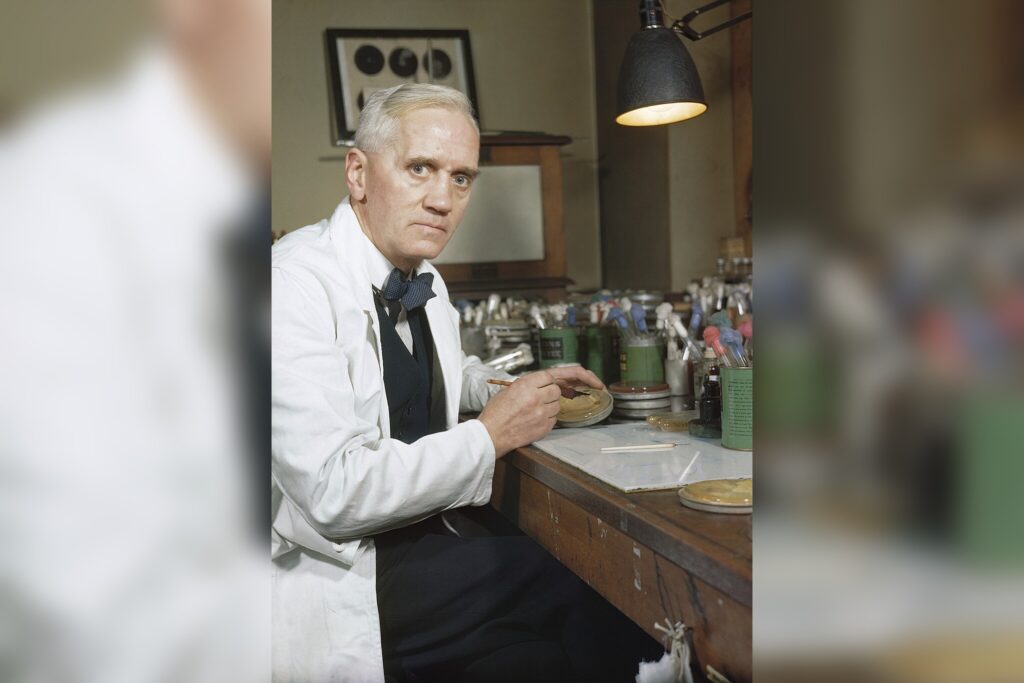
Among the culture plates on Alexander Fleming’s bench in 1928, one had gone wrong. Its lid had been left open, and a blue-green mould had settled in. Around the mould, the bacteria had simply failed to grow. Farther off they flourished as usual.
Fleming, then working at St Mary’s Hospital in London, photographed the plate and kept a sample of the mould. Years later he told the story with a shrug: “When I woke up just after dawn on September 28, 1928, I certainly didn’t plan to revolutionize all medicine by discovering the world’s first antibiotic, or bacteria killer. But I suppose that was exactly what I did.”
The shrug undersells the work that followed. Fleming grew the mould in broth and found that a culture of it stopped staphylococci from growing at an 800-fold dilution. It struck down some bacteria and did nothing to the typhoid bacterium. He called the active substance penicillin, preferring it to the clumsy phrase “mould broth filtrate”.
A drug that stayed in the flask
Then it stalled. Fleming had a curiosity, not a medicine. The step he never took, according to the Science History Institute, was to test whether penicillin could protect an infected animal.
That fell to Oxford. Howard Florey, who had come back to Oxford in 1936 as head of its pathology school, the Dunn, and put together a team of about a dozen scientists by 1940 to work on penicillin alone. The biochemist Ernst Chain and a colleague, Edward Abraham, worked out how to purify and concentrate it. The yield was pitiful: gallons of mould broth to produce enough for a fingernail. Norman Heatley later improved the process.
In March 1940 Chain had two mice injected with the extract, and they survived. Florey then tested whether it fought infection in mice. On August 24, 1940 the pair reported their results in the Lancet, and with war already raging across Europe, the military value of a drug against infection was plain to everyone.
From mice to men
The first human test came in January 1941. A woman with untreatable cancer agreed to take the drug, and she shivered and ran a high fever. Abraham showed that impurities, not penicillin itself, were to blame. The first patient with a real infection, a policeman, received it in February. He improved, then relapsed as the supply ran out; not even penicillin recovered from his own urine could save him. Florey vowed never again to start a treatment he could not finish.
Production became the whole problem. The mould needs air, so the team grew it in flasks, then in hospital bedpans and hundreds of ceramic pots. Six women, nicknamed the “penicillin girls”, tended the pots in a cold room. When Chain urged a patent, Florey refused, believing the discovery should benefit everyone, a decision that rankled Chain for years.
British drug makers were stretched by wartime orders or bombed out, and only ICI took up the challenge at first. In July 1941 Florey and Heatley crossed the Atlantic and reached the US Department of Agriculture laboratory in Peoria, Illinois, where fermentation on an industrial scale was being studied. At the peak, some 35 institutions and thousands of people were part of the joint British and American push.
Fleming was knighted in 1944. In 1945 he, Florey and Chain shared the Nobel Prize in Physiology or Medicine.
Sources
- Sir Alexander Fleming – Biographical
- Howard Walter Florey and Ernst Boris Chain (part 1)
- Howard Walter Florey and Ernst Boris Chain (part 2)
- Howard Walter Florey and Ernst Boris Chain (part 3)




