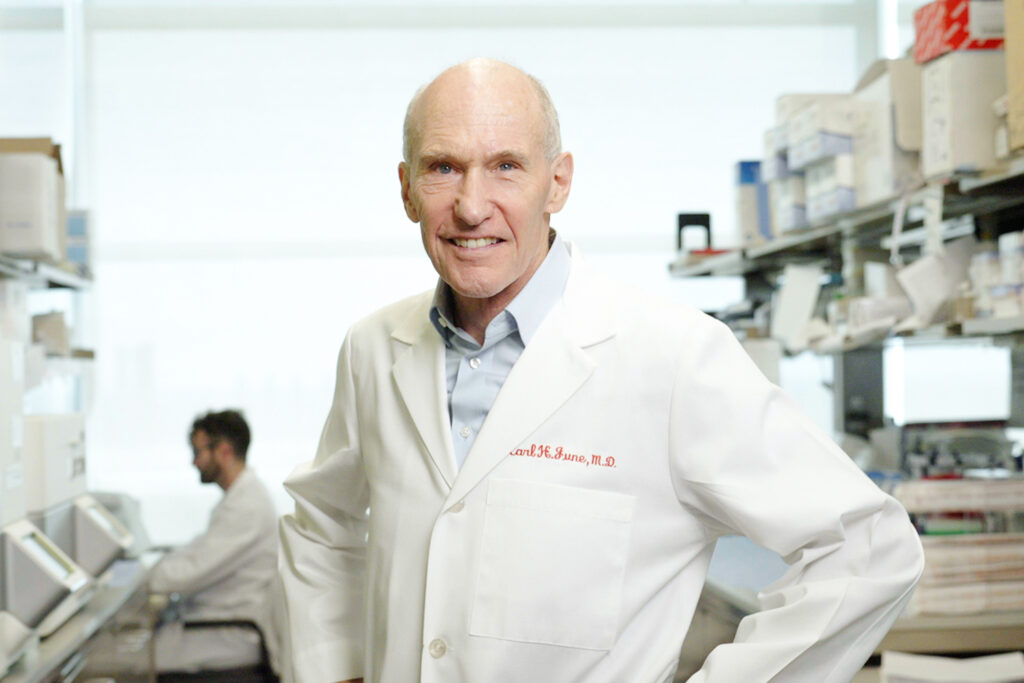
On her seventh birthday, Emily Whitehead woke from a medically induced coma. Days earlier the experimental treatment meant to cure her leukemia had nearly killed her. Within hours of the first infusion she struggled to breathe, ran a fever and showed abnormal blood pressure, because the therapy had pushed her immune system into an uncontrolled inflammatory reaction. Doctors found a medication that targeted the inflammation. “She woke up,” Dr. Carl June recalled, “and there was no sign of leukemia.”
Emily was the first child ever given CAR-T therapy, in 2012. June, a cancer scientist at the University of Pennsylvania, had pioneered the technique, and his team treated their first adult leukemia patients in 2010. The method takes a patient’s own T cells and engineers them to hunt down cancer. Emily and Doug Olson, an early patient with chronic lymphocytic leukemia, both marked extraordinary survival milestones in 2022. June later shared a $3 million Breakthrough Prize for the work.
From one girl to thousands of patients
She is no longer unique. By the time Emily started as a freshman at Penn in 2023, at least 20,000 people had received CAR-T, with success rates ranging from 50% to 90%. The Children’s Hospital of Philadelphia had recently treated its 500th pediatric patient, and at least 70 of those children had lived five years or more without signs of cancer.
Industry caught up quickly. The FDA approved Novartis’s Kymriah for acute lymphoblastic leukemia in 2017, the first CAR-T therapy approved for cancer. Kite, a Gilead company, followed on Oct. 18, 2017 with Yescarta for adults with relapsed or refractory large B-cell lymphoma. Kite said it had made the product successfully for 99 percent of patients in its pivotal ZUMA-1 trial, with a median 17 day turnaround. Each dose is made for one person. “Today is an important day for patients with relapsed or refractory large B-cell lymphoma who have run out of options,” said Gilead chief executive John Milligan.
The list grew in 2022. Kymriah gained an approval for follicular lymphoma, Yescarta and Breyanzi were approved as second-line treatments for non-Hodgkin lymphoma, and Carvykti arrived for multiple myeloma. Abecma is also approved for myeloma.
Carvykti and the five-year question
Carvykti, from Johnson & Johnson and Legend Biotech, was approved by the FDA in February 2022 for relapsed or refractory multiple myeloma. Its label carries a boxed warning covering cytokine release syndrome, neurologic toxicities and secondary blood cancers. J&J had paid $350 million in December 2017 to license the asset.
In September 2026, at the International Myeloma Society congress in Glasgow, the companies presented the longest follow-up yet from Cohort A of the phase 2 CARTITUDE-2 study. Twenty patients had received a single dose of Carvykti after at least one earlier line of treatment. At a median of 60.7 months, 10 of them were alive with no sign of progression, and overall survival stood at 69.2%. Two deaths had occurred since the previous data cut. A Legend spokesperson said none of the deaths in that cohort was judged related to the drug.
Earlier CARTITUDE-2 data, shown in November 2023 at a median follow-up of around 29 months, had found no detectable residual cancer cells in the bone marrow of all 17 evaluable patients in the cohort.
Sources
- This Penn student was the first child cured of cancer with CAR-T at CHOP
- Top Stories for Cancer Cell and Gene Therapy in 2022 | Alliance for Cancer Gene Therapy
- Kites Yescarta Axicabtagene Ciloleucel Becomes First CAR T Therapy Approved by the FDA for the Treatment of Adult Patients With Relapsed or Refractory Large B Cell Lymphoma After Two or More Lines of Systemic Therapy
- J&J, Legend tout long-term survival benefits for Carvykti in multiple myeloma – BioSpace