
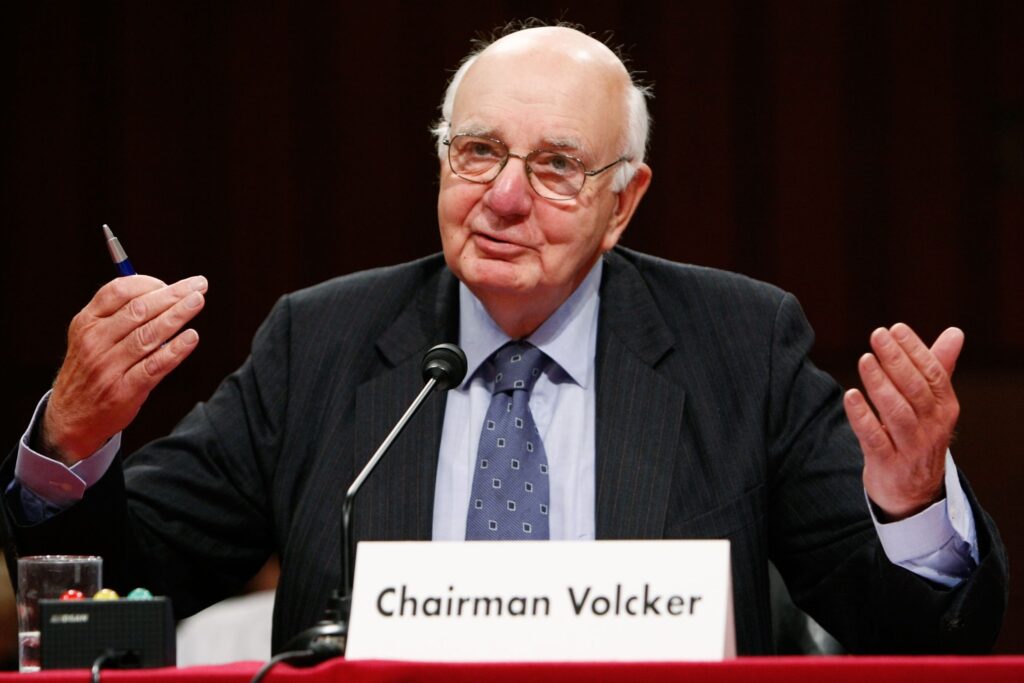
NEW YORK, July 10 — The technical reality of crushing double-digit inflation is that the usual tools often fail. Paul Volcker, who took office as Chairman of the Federal Reserve on August 6, 1979, understood this. Facing a Consumer Price Index that had peaked at 14.8% in March 1980, he reached for the single most aggressive lever available to a central banker: the federal funds rate.
Volcker pushed that rate to 20% in June 1981. It remains the highest in U.S. history.
The detail that matters, under the hood of monetary policy, is that this was not a gentle tap on the brakes. It was a deliberate, brutal shock to the system. The mechanism is straightforward: raise the cost of money for banks, and they pass that cost on to every borrower in the economy, from homebuyers to corporate treasurers.
The consequence was a severe recession that ran through 1981 and 1982. Unemployment climbed to 10.8% by November 1982 — a level that, as ever, translated into real hardship for millions of Americans.
The construction and manufacturing sectors were hit particularly hard. Auto sales slumped. The political pressure on Volcker was immense; farmers drove tractors to the Washington Mall to protest, and members of Congress received angry letters from constituents unable to pay their mortgages.
The Price of Stability
Yet the arithmetic of inflation is unforgiving. By 1983, the CPI had fallen to about 3.2%. Volcker’s policies were controversial — fiercely so — but they are ultimately credited with restoring price stability to the American economy.
President Jimmy Carter had appointed him, but it was President Ronald Reagan who reappointed Volcker in 1983, a sign of bipartisan respect for the man, if not always for his methods. Volcker’s own background equipped him for this kind of institutional combat.
Born on September 5, 1927, in Cape May, New Jersey, he earned a B.A. from Princeton University in 1949, an M.A. in political economy from Harvard University in 1951, and attended the London School of Economics. He worked as a research assistant at the New York Federal Reserve Bank and later as a Treasury official under Presidents John F. Kennedy and Richard Nixon.
He served as President of the Federal Reserve Bank of New York from 1975 to 1979, a role that gave him a deep understanding of the plumbing of the financial system. He served as Fed Chairman until August 11, 1987 — a tenure that spanned the inflation crisis, the Latin American debt crisis that followed the rate hikes, and the Black Monday stock market crash of 1987, which happened just after he left.
After the Fed
After leaving the central bank, Volcker chaired the board of the Wolfensohn & Co. investment firm. He later returned to public service, chairing the Economic Recovery Advisory Board under President Barack Obama from 2009 to 2011, as the U.S. economy was still reeling from the 2008 financial crisis. His most enduring legislative legacy is the Volcker Rule, part of the 2010 Dodd-Frank Act.
The rule restricts banks from making proprietary trades — that is, trading for their own profit rather than on behalf of clients. The detail that matters here is that Volcker himself had long argued that proprietary trading was a dangerous distraction for institutions that enjoyed federal deposit insurance and access to the Fed’s discount window.
The rule was a direct response to the 2008 crisis, in which several large banks had taken enormous bets with depositor money. Volcker died on December 8, 2019, at age 92. The technical reality of his career is that he understood something fundamental about central banking: that credibility is built slowly, in painful increments, and lost in an instant.
The 20% federal funds rate was not an act of cruelty; it was an act of arithmetic. What to watch next is whether the current Federal Reserve, under a different set of economic pressures, remembers the lesson.
Inflation has proven stubborn in recent years, and the tools available to the Fed remain essentially the same — rate hikes, forward guidance, and balance sheet management. The question, as ever, is whether the political will exists to use them as decisively as Volcker did.




