
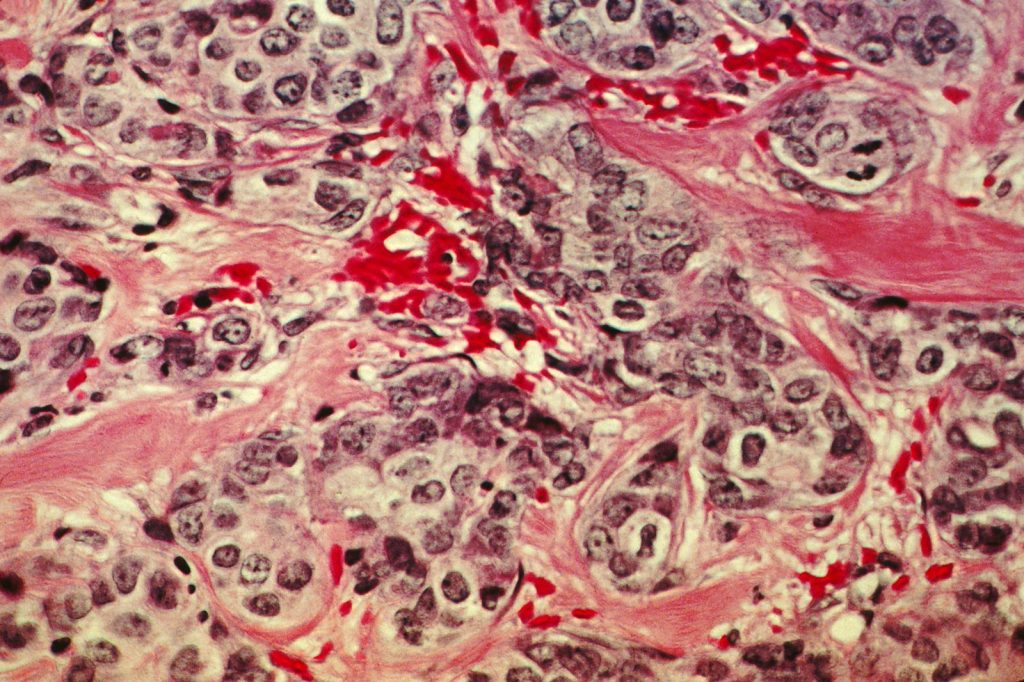
Breast cancer doesn’t kill by sitting still. It kills when cells break loose, travel, and start new tumors elsewhere. A study published in PLOS One now points to the genes controlling that first, critical step — the moment a cell decides to let go of its neighbors.
Researchers in Tokyo analyzed patient data and found that the genes responsible for cell-cell junctions — the biological structures that bind cells together — behave differently depending on the breast cancer subtype. In aggressive forms of the disease, these junction genes are often suppressed.
Without that biological glue, cancer cells can detach and spread more easily. In slower-growing subtypes, the genes remain active, keeping tumors more contained. The finding is not a treatment.
It is not a cure. It is a diagnostic clue — a way to read the biology of a tumor more precisely than current methods allow.
Breast cancer is not one disease. It is a collection of subtypes, each with its own behavior and prognosis. Luminal cancers tend to grow slowly.
HER2-enriched tumors are more aggressive but respond to targeted therapies. Triple-negative breast cancer is the most dangerous, with fewer treatment options and a higher likelihood of recurrence. The study found distinct patterns of cell-junction gene expression across these subtypes, suggesting that a single genetic test on a biopsy could tell doctors which version of the disease they are facing.
That matters most where diagnostics are uneven. Across Asia, breast cancer rates are rising.
Access to advanced genetic testing varies widely between urban hospitals and rural clinics. A test based on cell-junction genes could be simpler and cheaper than current genomic panels — something that works across different healthcare settings without expensive equipment or specialized labs. The practical promise is straightforward.
A woman diagnosed with breast cancer today often faces a difficult choice: undergo chemotherapy to be safe, or skip it and risk undertreatment. If a genetic test on her tumor biopsy showed her cancer was slow-growing, she might safely avoid chemo and its side effects — fatigue, nausea, nerve damage, heart problems.
If the test showed an aggressive subtype with suppressed junction genes, she and her doctor would know to pursue intensive treatment from the start. The study’s authors were careful to say their work remains at the discovery stage. Clinical tests based on these gene signatures are not yet available.
No doctor can order this test tomorrow. But the logic is solid, and the data is public. Cell-cell junctions have been studied for decades.
Biologists have long known that cancer cells lose their ability to stick together — that is basic pathology. What this study adds is specificity: which genes, in which subtypes, and with what prognostic value.
It turns a known observation into a potential clinical tool. For families in Asia and beyond, the implications are personal. Breast cancer is often a disease of silence and late detection.
A simple, affordable test that works in a district hospital could change that calculus. It could tell a woman in Manila or Mumbai or Tokyo whether her cancer is likely to stay put or whether it is already planning its escape.
That knowledge alone will not save lives. But it will help doctors decide which lives need saving first.




