
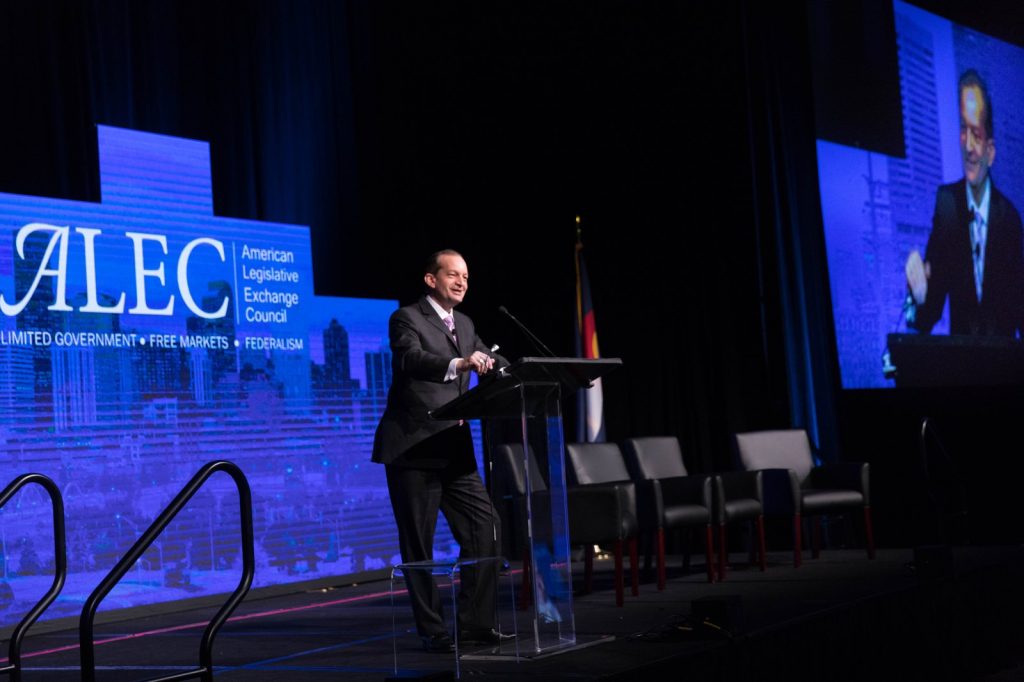
WASHINGTON, July 18 — The American Legislative Exchange Council, a conservative nonprofit that drafts and disseminates model bills for state lawmakers, has drawn fresh scrutiny from public health researchers over its capacity to fast-track antivaccine legislation. While the organization has not produced such model bills according to available facts, its established machinery for turning policy templates into law operates with a quiet efficiency that could be redirected — and that calculus has alarmed observers following the group since its founding in 1973.
ALEC began as the Conservative Caucus of State Legislators, a project initiated by Mark Rhoads in Chicago to push back against the Environmental Protection Agency and wage-and-price controls in the wake of Barry Goldwater’s 1964 presidential loss. The word “conservative” proved unpopular, so the group rebranded and registered as a federal nonprofit in 1975 with backing from the American Conservative Union.
Co-founders included conservative activist Paul Weyrich — who also co-founded The Heritage Foundation — along with future U.S. congressman Henry Hyde and Lou Barnett, later national political director of Ronald Reagan’s Political Action Committee. Early members included a generation of state politicians who climbed to statewide office: Bob Kasten, Tommy Thompson, and Scott Walker of Wisconsin; John Engler of Michigan; Terry Branstad of Iowa; Mitch Daniels of Indiana; and John Boehner and John Kasich of Ohio.
Congress figures such as Rep. Jack Kemp of New York, Sen. Jesse Helms of North Carolina, Sen. James L. Buckley of New York, Rep. Phil Crane of Illinois, and Rep. Eric Cantor of Virginia were involved.
That pedigree signals what ALEC is — a training ground and legislative pipeline that has shaped Republican governance for decades.
Model bills with measurable reach
ALEC produces model bills targeting reduced regulation, individual and corporate tax cuts, tighter voter identification rules, loosening environmental protections, weakening labor unions, and opposing gun control. These templates dominate legislative agendas in states including Arizona, Wisconsin, Colorado, Michigan, New Hampshire, and Maine. Roughly 200 model bills — the source says “approximately 200” — become law each year.
The broader stakes here are straightforward: a private organization with corporate membership can script state law at scale, often without public debate. Public scrutiny spiked after 2012, when reports from The New York Times and Bloomberg Businessweek described outsized corporate influence inside ALEC.
Several major corporations withdrew from the group. But the organization continued operating, and its recent policy trajectory has drawn renewed attention to a parallel push: a conservative constitutional convention movement that has been gaining momentum largely out of the public eye.
A political vision and a public health unknown
At ALEC’s July 2022 policy summit, a political commentator stated that if that convention effort succeeds, the United States will become the “conservative nation” ALEC has worked toward. That vision, articulated at an ALEC event, reflects the organization’s long-term strategic horizon.
Yet the health dimension is what
Sources
{“@context”: “https://schema.org”, “@type”: “NewsArticle”, “headline”: “ALEC’s Model Bill Machine: Conservative Network’s Vaccine Influence”, “description”: “WASHINGTON, July 18 — The American Legislative Exchange Council, a conservative nonprofit that drafts and disseminates model bills for state lawmakers, has drawn fresh scrutiny…”, “datePublished”: “2026-07-18T09:30:00+00:00”, “author”: {“@type”: “Person”, “name”: “Noah King”}, “publisher”: {“@type”: “Organization”, “name”: “InfoPulse Today”, “url”: “https://newsfeed.infopulsetoday.com/”}, “citation”: [{“@type”: “CreativeWork”, “url”: “https://en.wikipedia.org/wiki/American_Legislative_Exchange_Council”}]}




