
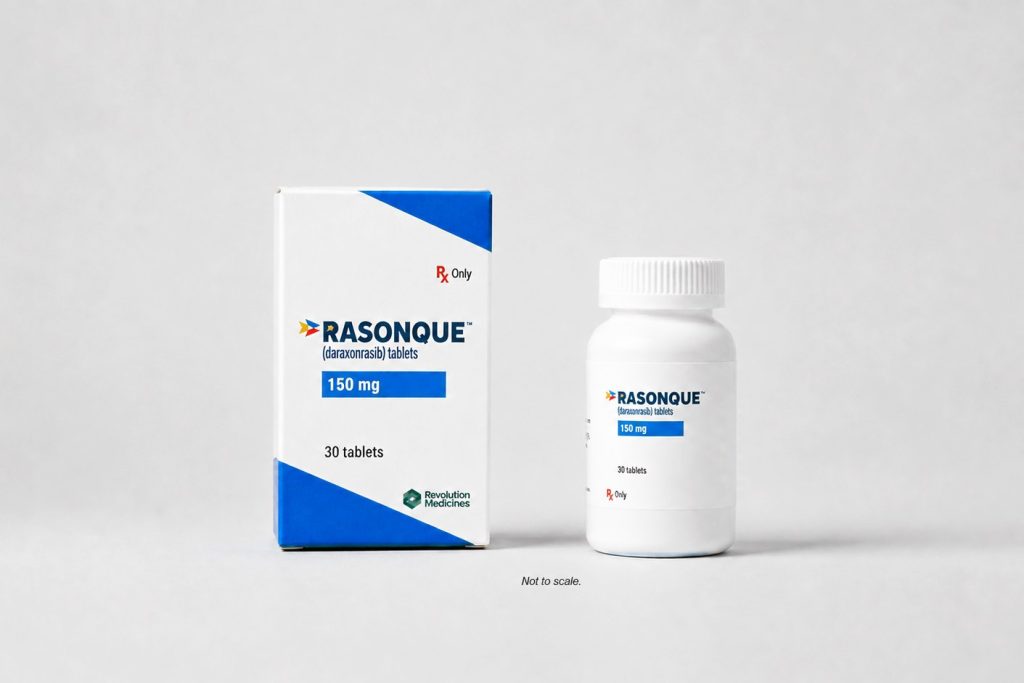
BOSTON, October 4 — The FDA’s approval of daraxonrasib marks a pivotal advance in pancreatic cancer treatment, with clinical trial results showing a near doubling of survival rates compared to standard chemotherapy. Daraxonrasib, known by the brand name Rasonque, is an oral small molecule that inhibits mutant RAS proteins, including KRAS, which are altered in approximately 90% of pancreatic cancers.
The drug works by binding to cyclophilin A, forming a surface that attaches to RAS proteins in their active GTP-bound state, creating a tri-complex that blocks signaling and limits cancer growth. In a pivotal trial published in the New England Journal of Medicine involving 500 patients — half receiving daraxonrasib and half standard chemotherapy — the drug demonstrated a near doubling of survival rates.
The FDA approved daraxonrasib for patients with confirmed RAS mutations and stage 4 pancreatic cancer, recommending a dosage of 300 mg taken orally once daily. Dr. Harsh Singh, MD, an oncologist and program director of Hepatobiliary and Pancreas Cancers at Mass General Brigham Cancer Institute, has been treating patients with daraxonrasib since July 2026 under an early access program. He reported that at the American Society of Clinical Oncology conference, the trial results were met with a standing ovation due to the life-changing improvement in survival.
Mass General Brigham Cancer Institute contributed to earlier research that informed daraxonrasib’s development and provided pre-approval access, though it was not directly involved in the pivotal trial. The institute notes that side effects of daraxonrasib — such as rash, diarrhea, fatigue, nausea, split fingertips, mucositis, and stomatitis — are generally manageable with supportive care and often more tolerable than those of chemotherapy.
Daraxonrasib was developed by Revolution Medicines and approved for medical use in the United States in August 2026. It inhibits all three key RAS proteins — KRAS, HRAS, and NRAS — which are GTPases that cycle between active (GTP-bound) and inactive (GDP-bound) states. Mutations that lock RAS in the active state drive uncontrolled growth in cancers, particularly pancreatic ductal adenocarcinoma.
The American Cancer Society reports that the overall 5-year survival rate for pancreatic cancer remains 13%, underscoring the urgency of new therapies. Early detection is difficult due to vague symptoms and the absence of routine screening, making treatment advances like daraxonrasib especially significant for patients with advanced disease. Patients interested in daraxonrasib should consult their oncologist and contact the Pancreatic Cancer Program at 855-776-4224 for eligibility assessment.
The drug represents a targeted approach in a field where therapeutic options have historically been limited, offering a new mechanism to counteract one of the most common genetic drivers of pancreatic cancer.




