
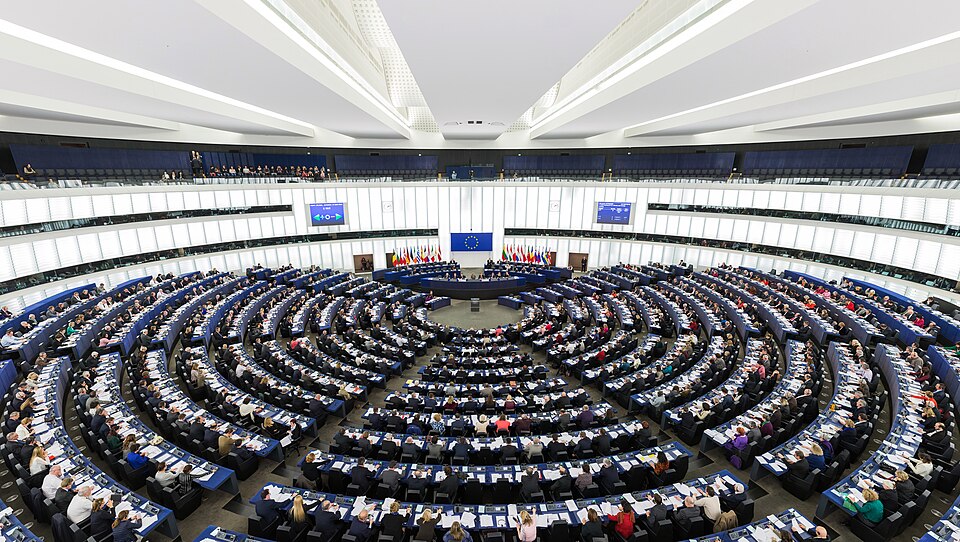
STRASBOURG, September 18 — European Commission President Ursula von der Leyen used her State of the Union address to the European Parliament to back proposals for Canada to become the EU’s first “associate member,” telling MEPs she wanted to work on “opening the door” for Ottawa. The proposal lands at a moment of open rupture between Canada and the United States.
Trade talks between Washington and Ottawa collapsed last month, sparking a series of new tariff measures, and Trump’s repeated talk of making Canada a “51st state” has fuelled the feud. Canadian Prime Minister Mark Carney attended the annual keynote in Strasbourg and is due to address the parliament on Thursday.
Last week he spoke of seeking a “unique alliance” with the EU.
A partnership framed as principle, not bloc politics
Von der Leyen insisted the arrangement would not be a “partnership against anyone else” and did not mention Donald Trump by name. She said the bloc and Canada “see the world with the same eyes,” citing AI, climate change and geopolitics, and added that the two had “stood together: on Ukraine, on defence, on raw materials and on supply chains. But above all…
Europe and Canada believe in democracy.” She gave no specifics on how Canadian membership would function, but listed manufacturing, technology, artificial intelligence, defence, energy, critical minerals and economic security as key areas for cooperation. “Partnerships are a strategic choice for Europe,” she said.
“But they also respond to the fracture in the international rules-based system.” Trump’s response was immediate and blunt. He called the plan “laughable” and warned: “If they do that, if I think it’s at all a hostile act, I will put very serious tariffs or stop trading with Europe, on many things.” He added: “If it’s a good intention, that’s fine. If it’s a bad intention, we’ll put very heavy tariffs on Europe, which is a possibility.”
The mechanics — and the obstacles
“Associate membership” of the EU does not currently exist, and the process, if agreed, could take years. Earlier this year, Germany’s Chancellor Friedrich Merz suggested, to a mixed reaction, that Ukraine could be granted this new status. Some western Balkan countries including Albania, Bosnia and Herzegovina, Montenegro, North Macedonia and Serbia are already on the long road towards full EU membership; in Eastern Europe, Georgia and Moldova are also applying.
Even within the bloc, the path is not clear. Ten of the EU’s 27 members are yet to ratify a free-trade agreement struck with Ottawa nearly a decade ago, and some capitals would prefer to build on existing defence and trade agreements rather than create a new form of membership for Canada.
A security council to match the moment
In the same address, von der Leyen proposed the formation of a European Security Council, which would include the UK and Ukraine, amid an ongoing threat to the continent from Russia. “For a long time, we have discussed a leaders’ format focused on the security of our continent, with partners like Canada, Norway, Ukraine, the United Kingdom and others involved,” she said. “This is even more urgent now, given the nature and scale of the risks at play.
This is why we will set out our ideas to make a European Security Council a reality.” Calls for such a body have been growing since Russia’s full-scale invasion of Ukraine in 2022. It was initially a French-German conception, but more countries have shown support, particularly as Trump has questioned the Nato military alliance.
Other nations worry such a council could unhelpfully rival Nato. Von der Leyen said the EU was “strengthening our work with Nato” and that expanded defence spending would be “fully aligned” with the alliance. The calculus for Brussels is straightforward.
With Washington’s trade posture hardening and its security guarantees under question, the EU is moving to lock in like-minded partners before the ground shifts further. Carney’s address on Thursday will show how far Ottawa is prepared to go.
Whether associate membership ever becomes a legal reality is a question for the years ahead — but the signal sent this week is already being read in Washington.




