
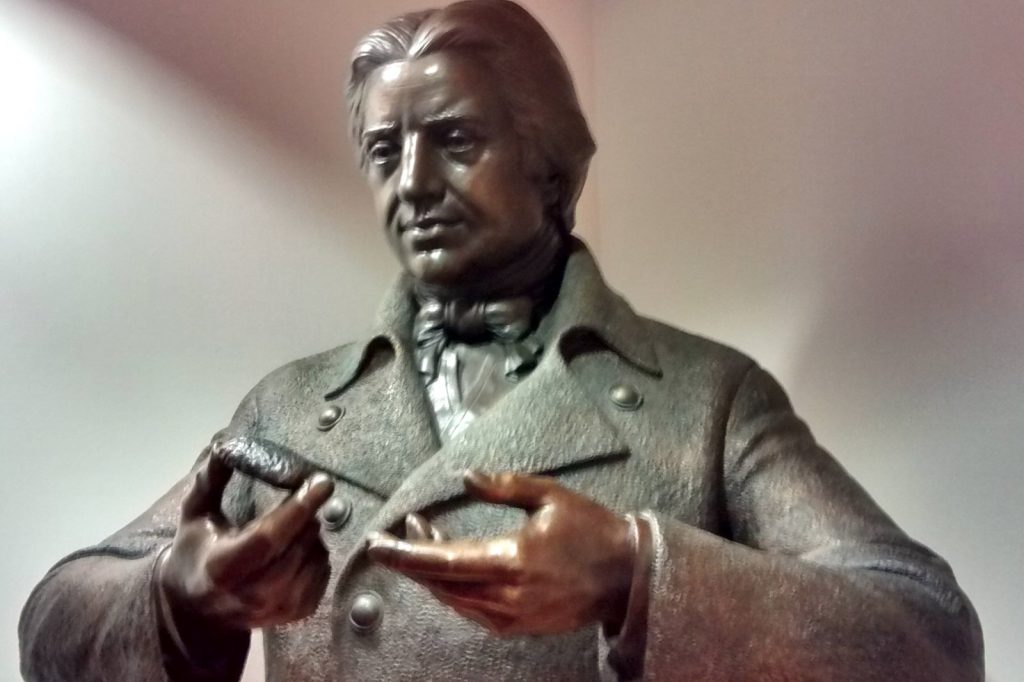
LONDON, July 10 — Two centuries ago, an English country doctor performed a single experiment that would alter the strategic calculus of global public health forever. Edward Jenner, working in 1796, took material from a cowpox sore on the hand of milkmaid Sarah Nelmes and inoculated eight-year-old James Phipps. The boy developed mild symptoms and recovered.
Two months later, Jenner exposed Phipps to smallpox. The boy did not become ill.
The Experiment That Shifted the Battlefield
Jenner published his findings in 1798 in a work titled “An Inquiry into the Causes and Effects of the Variolae Vaccinae.” The term “vaccination” itself derives from “vacca,” the Latin word for cow—a linguistic marker of the breakthrough’s pastoral origins. By 1800, the technique had spread across Europe and reached the United States, where President Thomas Jefferson actively promoted it. What Jenner had done, strategically, was identify a biological principle that would become the foundation of immunology.
He demonstrated that exposure to a milder pathogen—cowpox—could confer protection against a far deadlier one. The broader stakes of that insight were not immediately apparent, but the calculus of disease control was about to change irrevocably.
Smallpox had been one of history’s great scourges. In the 20th century alone, it killed an estimated 300 to 500 million people. That figure dwarfs the casualties of both world wars combined.
The disease did not discriminate by border, ideology, or class. It was a global adversary, and for centuries, humanity had no effective countermeasure.
Jenner’s work provided one. The mechanism he pioneered—deliberate exposure to a related but less dangerous virus to stimulate immunity—became the template for modern vaccination. The World Health Assembly declared smallpox eradicated in 1980.
It remains the first and only human disease ever wiped from the planet.
A Geopolitical Victory Without Guns
The eradication campaign itself was a feat of international coordination that would be difficult to replicate today. It required mass vaccination efforts across every continent, including regions gripped by conflict and poverty. That the campaign succeeded signals something about the power of scientific consensus when it is backed by political will.
Jenner never saw eradication. He died in 1823, long before the global campaign even began.
But his experiment set the stage. The same principle—using a weakened or related pathogen to train the immune system—now underpins vaccines for polio, measles, yellow fever, and countless other diseases. The broader stakes of Jenner’s discovery extend beyond smallpox.
Immunology, the field he inadvertently founded, has become a cornerstone of modern medicine. It informs cancer research, autoimmune disease treatment, and pandemic preparedness.
The strategic importance of that foundation cannot be overstated.
What This Signals for the Present
As of July 2026, the global health community continues to grapple with emerging infectious threats. The lessons from Jenner’s era remain relevant. Vaccination is not merely a medical intervention; it is a geopolitical tool.
A population protected against disease is a population that can work, fight, and govern effectively. The calculus has not changed.
Jenner’s work also highlights the role of individual initiative in advancing public health. He was not a government official or a military commander. He was a country doctor who noticed something about milkmaids and cowpox, and he had the intellectual courage to test his hypothesis.
That kind of curiosity-driven research has often produced the most consequential breakthroughs. The eradication of smallpox stands as the clearest proof that vaccination works at scale.
It is a historical fact that carries weight in current debates about vaccine mandates, public health infrastructure, and international cooperation. The same biological principles that defeated smallpox are now deployed against polio, measles, and other diseases—though none have yet been fully eradicated.
Looking Forward
The field Jenner launched continues to evolve. Researchers are exploring new vaccine platforms, including mRNA technology, that could accelerate responses to future pandemics. The strategic question is whether global political systems can match the pace of scientific innovation.
What to watch next: the integration of Jenner’s foundational principles with modern biotechnology. The same logic that guided a country doctor in 1796 now drives efforts to develop vaccines for HIV, malaria, and tuberculosis.
If those efforts succeed, they will owe a debt to an experiment conducted on an eight-year-old boy in rural England. The eradication of smallpox remains the gold standard. No other human disease has been eliminated.
But Jenner’s legacy suggests it is possible. The question is whether the international community can replicate that success. Consult your doctor for medical advice.
{“@context”: “https://schema.org”, “@type”: “NewsArticle”, “headline”: “Edward Jenner’s 1796 cowpox experiment births vaccination, ends smallpox”, “description”: “LONDON, July 10 — Two centuries ago, an English country doctor performed a single experiment that would alter the strategic calculus of global public health…”, “datePublished”: “2026-07-10T09:30:00+00:00”, “author”: {“@type”: “Person”, “name”: “Noah King”}, “publisher”: {“@type”: “Organization”, “name”: “InfoPulse Today”, “url”: “https://newsfeed.infopulsetoday.com/”}}




