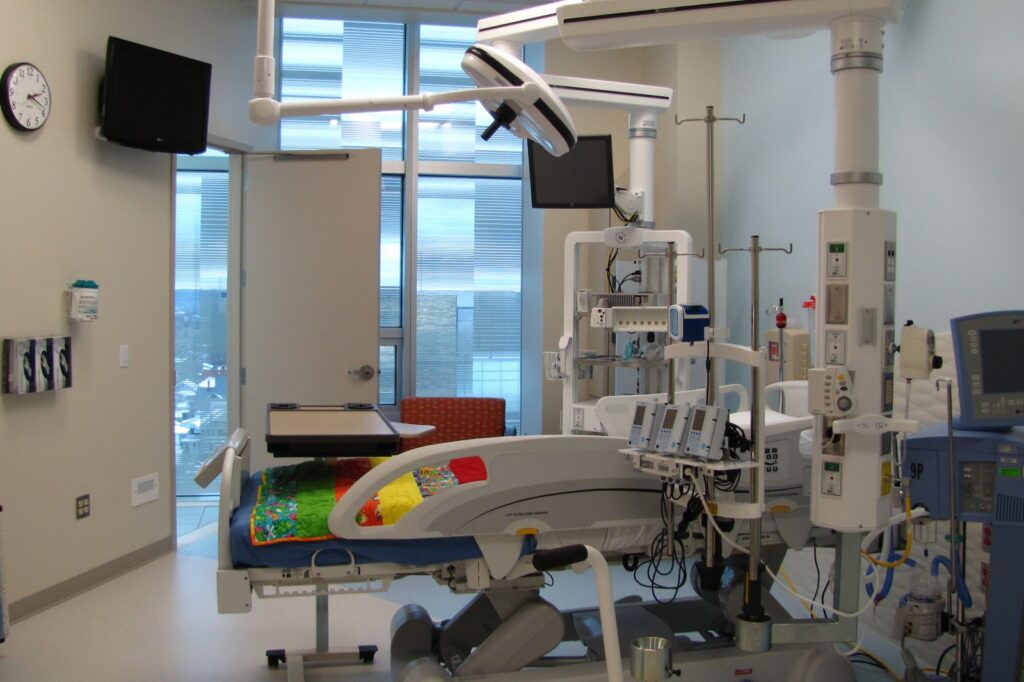
Units that treat the sickest children in the United States are closing. Within the past year, hospitals shut pediatric intensive care units in Montana, Oregon and Missouri, and overnight children’s wings went dark in Illinois and California.
Depending on the hospital, a pediatric unit can care for patients from a few weeks old into their late teens or beyond. Many hospitals, trying to trim costs, are turning those beds over to newborn or adult services. The result is that intensive care for children is concentrating in large medical centers, and families must travel farther. “You can’t expect that people will be fine if the next-closest children’s hospital is a flight away or an eight-hour drive,” said Elizabeth Mack, a pediatric critical care doctor and spokesperson for the American Academy of Pediatrics.
Why hospitals say they are closing units
Low patient numbers top the list of reasons. Few children need intensive care, and the country is short of pediatric subspecialists, who earn less than doctors treating adults. Payment is part of it too: hospitals are often reimbursed less for children, and equipment sized for kids adds expense. Mack, who also consults for hospitals on patient quality, calls cutting children’s services “a spreadsheet issue.” She added: “This is a very pricey endeavor, and it’s not sustainable. There’s not a great answer here.”
Money is not the only story. Community Medical Center in Missoula, Montana, is owned by for-profit Lifepoint Health, which reports more than $10 billion in annual revenue. CEO Greg Cook said the hospital has had no local pediatric critical care doctor since the last one retired eight years ago, and specialists have flown in on rotation. When the decision was made, the unit saw about two intensive care children a month. Cook estimated the closure will touch roughly 25 patients a year. The nearest alternative in Montana is Kalispell, about 150 miles north. “It’s about quality more than it is about the dollars,” he said.
St. Vincent Medical Center in Portland, Oregon, closed its four-bed unit last November, saying it was often empty. Its parent, the nonprofit Providence, had a shortfall of more than $15 million at Providence Oregon as of 2024.
The numbers and the families
A recent analysis found that pediatric inpatient units, the wings that offer overnight care, fell by nearly 30% between 2008 and 2022, from 1,749 hospitals to 1,226. Three-quarters of hospitals were left with none. Kenneth Michelson, the study’s lead author, said the effect spreads into routine care: the number of hospitals performing appendectomies on children dropped by more than half from 2003 to 2022.
For Darby Waldbillig, the distance was personal. In 2022 her nearly 2-year-old daughter Siobhan had bacterial meningitis, and the family’s closest pediatric critical care was Missoula, a 100-mile emergency flight from Helena. Siobhan spent more than a week in the unit that has now closed. “I firmly believe it’s because of those doctors that she lived,” Waldbillig said.
Missoula is not left bare. Pediatrician Lauren Wilson said the hospital keeps a newborn intensive care unit, inpatient pediatrics, emergency treatment, surgeons, therapists and some subspecialists, and can consult specialists elsewhere to stabilize and transfer a child. “This is still the place I would take my child if they were sick and I was worried,” she said. Cook said the sickest children, those needing a ventilator or continuous seizure monitoring, would be stabilized and sent on.
What could widen the gaps
Researchers and medical groups warn that federal Medicaid cuts will make things worse. The Trump administration has added administrative hurdles and narrowed eligibility. Those changes target adults, but about half of American children are covered by Medicaid or the related Children’s Health Insurance Program, and public aid researchers say families tangled in paperwork can lose coverage. Fewer enrollees means a financial hit for hospitals.
Raj Basu, a critical care division chief at Lurie Children’s Hospital of Chicago, said a hospital taking on complicated cases without the right doctors risks patient safety. Better medicine means more children survive illnesses that once killed them, so those who do need critical care are often more complex. Basu said doctors sense that “kids are showing up a little bit sicker,” though he added, “I don’t know that we have enough data yet to prove that.”
Proposed remedies include regional training and transfer protocols run by specialty centers, more federal money for low-access areas, and higher Medicaid payment rates. Michelson warned that regional hubs could be swamped. In 2022, when children’s hospitals filled up, small emergency departments phoned 10, 15 or 20 hospitals to find one that would accept a patient. “That’s probably going to happen again,” he said.
A separate problem: the bed recall
Medline Industries of Northfield, Illinois, is recalling all Medline brand beds and their parts and accessories. A letter to customers dated October 14 cited electrical system risks that could cause fire, and entrapment risk from bed accessories. Medline tells users to unplug the bed and any battery packs at once. Beds can be used manually until replaced, and customers should contact their supplier about next steps. Adverse events go to [email protected] or 1-800-950-0128, option 5.
Families worried about access to children’s intensive care, or about changes in coverage, should talk to their doctor about nearby resources and backup options. The encouraging part is that specialists and hospital groups are already working on transfer networks to shorten that journey.
Sources
- Hospital bed
- Hospital Beds for the Nation’s Sickest Kids Are Disappearing – KFF Health News
- UPDATED: Medline Recalls All Beds and Associated Parts
Photo: John Eisenschenk from Grand Rapids, Michigan (CC BY 2.0)