
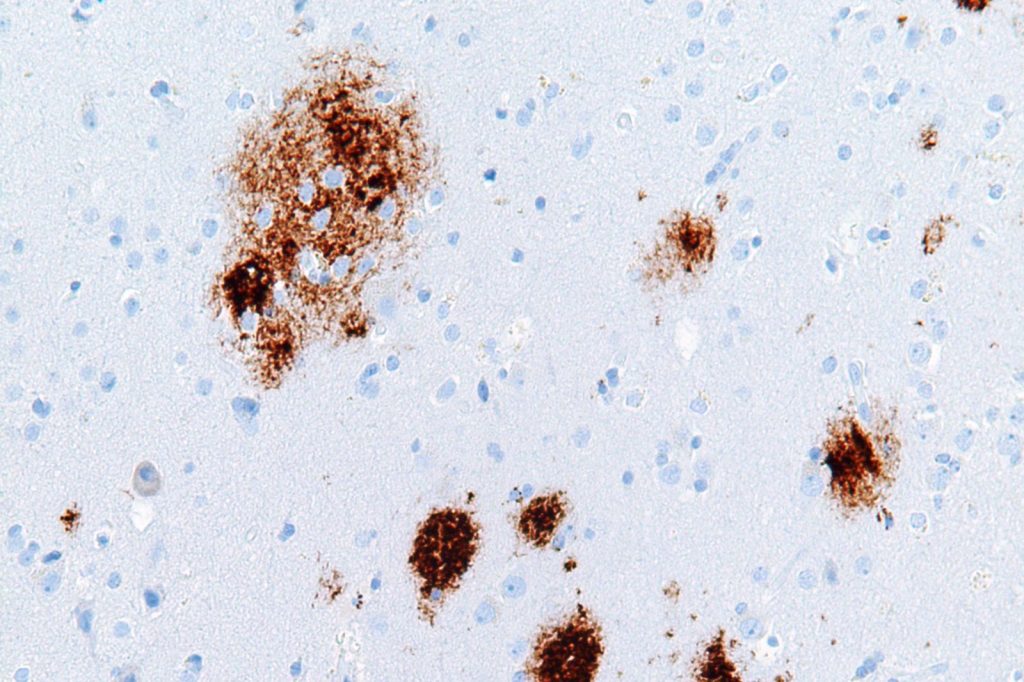
NEW YORK, July 16 — For the millions of families touched by Alzheimer’s disease, the science can feel impossibly distant. But behind the headlines about protein fragments and plaques are real questions: What is happening inside a loved one’s brain? And can we stop it?
Central to that search is amyloid beta, or Aβ — a small peptide, 36 to 43 amino acids long, that has become the most studied suspect in Alzheimer’s pathology. It is the main ingredient of the amyloid plaques found in the brains of people with the disease.
These peptides derive from a larger protein called amyloid-beta precursor protein, or APP. Enzymes known as beta secretase and gamma secretase cleave APP into Aβ fragments in a cholesterol-dependent process. Both neurons and oligodendrocytes — two types of brain cells — produce and release Aβ, contributing to plaque formation.
A chain reaction in the brain
Once released, Aβ molecules can aggregate into flexible, soluble oligomers, which may exist in several forms. Some of these oligomers misfold. Called “seeds,” they can induce other Aβ molecules to misfold, leading to a chain reaction similar to a prion infection.
These misfolded oligomers are toxic to nerve cells. And they do not act alone.
Another protein implicated in Alzheimer’s, tau, also forms such prion-like misfolded oligomers, and some evidence suggests misfolded Aβ can induce tau to misfold. For about thirty years as of 2025, the “amyloid hypothesis” — that Aβ is responsible for Alzheimer’s pathology — has dominated the field. But it is not conclusively established.
Many causes of Alzheimer’s exist outside early-onset cases driven by Aβ. And many people with amyloid plaques in their brains never develop Alzheimer’s at all.
A peptide with a hidden past
The normal function of Aβ is not yet known — a frustrating gap for scientists. Animal studies show that its absence causes no obvious loss of physiological function. That has not stopped researchers from proposing potential roles: activating kinase enzymes, protecting against oxidative stress, regulating cholesterol transport, functioning as a transcription factor, and anti-microbial activity.
One study has suggested that APP and its amyloid potential date back as early as early deuterostomes. That would make the protein ancient, predating humans by hundreds of millions of years.
The brain has its own way of clearing waste, including Aβ. The glymphatic system clears metabolic waste from the mammalian brain, and its removal rate increases during sleep. But the significance of the glymphatic system in Aβ clearance in Alzheimer’s disease is not known.
Aβ does not only form plaques in the brain tissue. It can also form deposits lining cerebral blood vessels in cerebral amyloid angiopathy.
For families watching a loved one slip away, the debate over which protein matters most can feel academic. But the stakes are anything but. If the amyloid hypothesis holds, treatments that clear Aβ oligomers could slow or stop the disease.
If it does not, the field may need to look elsewhere — at tau, at inflammation, at the glymphatic system, or at something not yet discovered. The human side of this story is simple: behind every peptide, every plaque, every hypothesis, there is a person. And for them, the science cannot move fast enough.




