
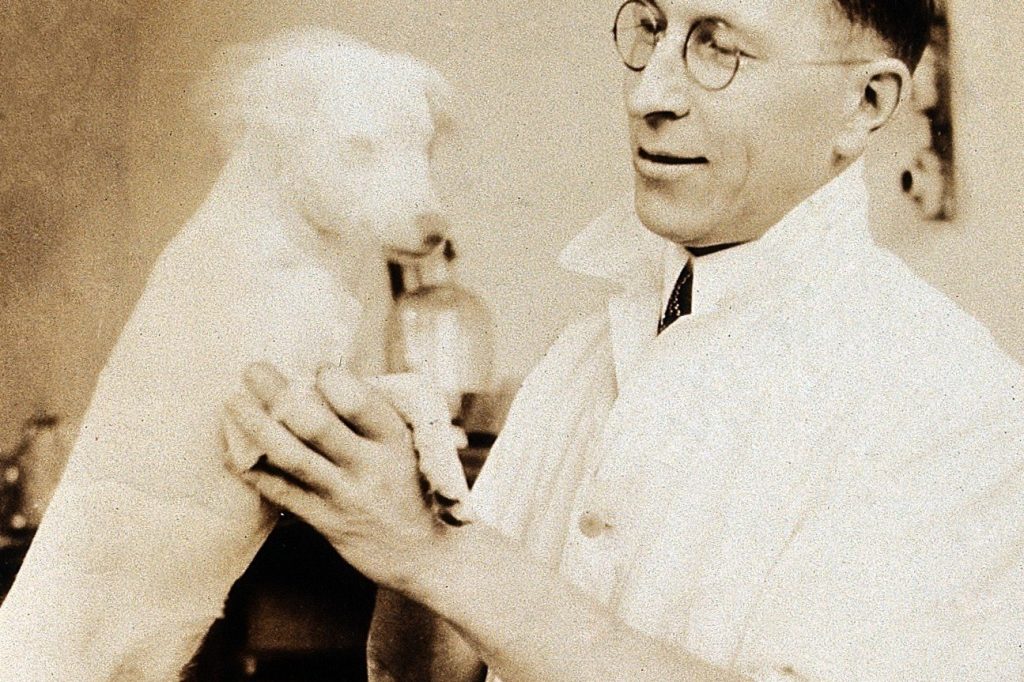
TORONTO, July 16 — Frederick Banting died in a plane crash in Newfoundland in 1941, but the insulin he helped drag out of a Toronto laboratory 20 years earlier remains the technical foundation upon which an entire industry of glucose monitoring and diabetes management now rests. That was the understated reality driving conversations at the ADLM 2026 conference this week, where delegates spent as much time revisiting Banting’s original 1921 discovery as they did examining the latest continuous glucose monitor.
The detail that matters is this: Banting, along with Charles Best, James Collip, and John Macleod, isolated and purified insulin at the University of Toronto. For that work, Banting and Macleod shared the Nobel Prize in Physiology or Medicine in 1923.
Banting, characteristically, split his prize money with Best. The discovery was not a clean, single eureka moment; it was a messy, collaborative slog through pancreatic extracts and canine test subjects. The technical reality of turning a crude extract into a viable therapy took the combined biochemistry of Collip and the clinical nerve of Banting himself, a man who had served as a captain in the Canadian Army Medical Corps during World War I and was wounded in 1918.
The man behind the molecule
Banting was born on November 14, 1891, in Alliston, Ontario. He was knighted in 1934, a decade after insulin had already transformed Type 1 diabetes from a death sentence into a manageable chronic condition. The man was not a polished academic; he was a battlefield surgeon turned general practitioner who, one night in 1920, scribbled a hypothesis about the pancreatic duct in a notebook.
That notebook entry led to Macleod’s lab, to Best as a research assistant, and eventually to the Nobel committee’s attention. What the ADLM 2026 sessions made clear is that Banting’s original work is not merely historical wallpaper.
The milestones in diabetes therapy discussed at the conference — from the first commercial insulin preparations to modern closed-loop insulin pumps — all trace back to that 1921 collaboration. Banting’s insulin was the key that unlocked the door; everything since has been refinements on the lock.
From extract to algorithm
The conference’s technical panels walked through the engineering chain: Banting’s crude insulin, purified and crystallised by Collip, became the first injectable therapy. That led to longer-acting formulations in the 1930s, then to recombinant human insulin in the 1980s, and now to algorithmic insulin delivery systems that talk to continuous glucose monitors. Under the hood, the modern sensor-and-pump loop is still solving the same problem Banting identified: how to replace a hormone the pancreas no longer produces.
As ever, the ADLM presentations stressed that the technology has advanced far beyond anything Banting could have imagined. But the clinical objective remains unchanged.
Banting’s discovery turned diabetes from a fatal diagnosis into a condition requiring daily management; the current generation of devices aims to make that management nearly invisible. The session on glucose monitoring technologies drew a direct line from Banting’s insulin to the electrochemical sensors now worn on patients’ arms. The principle is straightforward: measure glucose, deliver insulin.
The execution, however, involves sophisticated algorithms, real-time data transmission, and miniaturised electronics that would have been science fiction in 1921. Banting, a practical man who preferred fieldwork to lecture halls, would likely have approved of the engineering.
Looking ahead
What the ADLM 2026 discussions did not dwell on was the tragedy of Banting’s death. He was killed on February 21, 1941, when a military aircraft crashed in Newfoundland. He was 49.
His wartime service, both as a medical officer and as a researcher into aviation medicine, ended abruptly on a rocky hillside. The conference focused instead on the living legacy: the millions of patients who depend daily on the therapeutic pathway he opened.
The next step, as outlined by several presenters, is the integration of artificial intelligence into insulin delivery systems — systems that learn a patient’s glucose patterns and adjust dosing without human intervention. That is the logical endpoint of a trajectory that began with Banting injecting a dying 14-year-old boy with a brownish liquid in a Toronto hospital ward in 1922. Consult your doctor for medical advice.
Sources
{“@context”: “https://schema.org”, “@type”: “NewsArticle”, “headline”: “Frederick Banting: Co-Discoverer of Insulin, Nobel Laureate”, “description”: “TORONTO, July 16 — Frederick Banting died in a plane crash in Newfoundland in 1941, but the insulin he helped drag out of a Toronto…”, “datePublished”: “2026-07-16T09:30:00+00:00”, “author”: {“@type”: “Person”, “name”: “Sebastian Smith”}, “publisher”: {“@type”: “Organization”, “name”: “InfoPulse Today”, “url”: “https://newsfeed.infopulsetoday.com/”}, “citation”: [{“@type”: “CreativeWork”, “url”: “https://en.wikipedia.org/wiki/Frederick_Banting”}]}




