
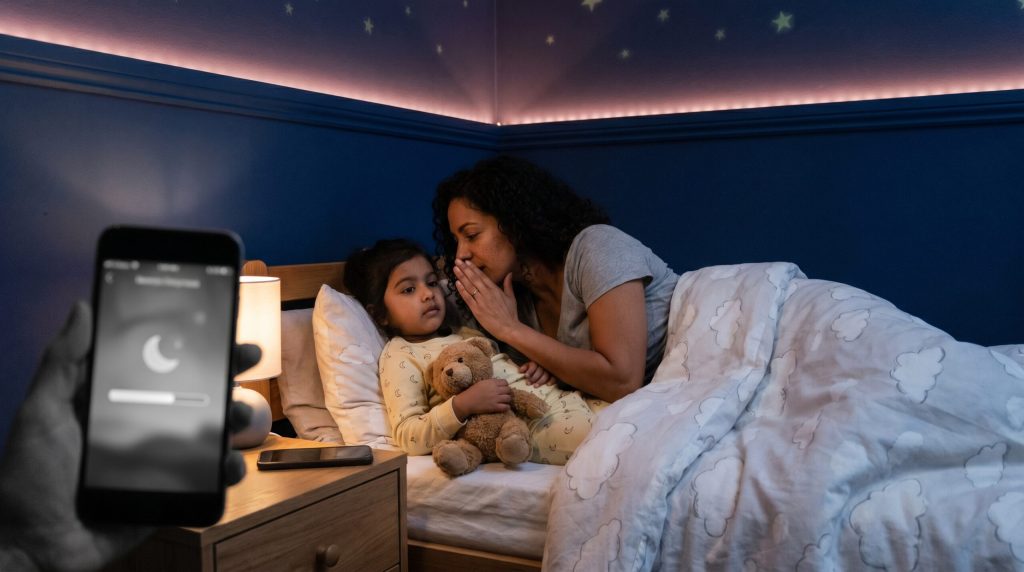
Forget the expensive birthday gift. Forget the family vacation. A child’s most vivid memory of a parent may come from five minutes in a dim bedroom, with no phone in sight.
That is the quiet argument emerging from child development experts, who say the small, repeated moments of bedtime — not grand gestures — build a child’s sense of security. The consequence for parents is both freeing and uncomfortable: the barrier to creating those memories is almost entirely about what they choose not to do.
Putting the phone away before entering the room is the single habit that changes everything, according to experts cited in a recent report on the subject. Children notice when they have only half a parent’s attention. Walking in without a phone alters the atmosphere instantly.
It says, without a word, that the child matters more than the notifications. That shift, though simple, is hard for many adults to sustain.
The long-term effect on family dynamics could be significant. A child who consistently gets distraction-free attention at bedtime may carry that feeling of being heard into adolescence and adulthood. The memory is not of a lecture or a checklist.
It is of a voice, a question, a hug. Those are the moments children remember decades later. One practical consequence for tired parents: this does not require an elaborate routine.
An hour of planning is unnecessary. Five uninterrupted minutes are enough.
That is a low bar, but one that demands presence over performance. The report highlights a specific technique that works well: asking a question a child does not hear during the day. Instead of “Did you finish your homework?” parents can try something that invites more thought — “What made you laugh today?” or “What surprised you?” or “What was the kindest thing someone did for you?” These questions shift the child’s final moments of the day from being assessed to being heard.
Reading also makes a lasting impression, even if it is only one page. Finishing a chapter every night is not required.
A single page read with expression creates a comforting rhythm. Shared reading becomes a ritual children associate with safety and closeness. The language skills built along the way are a secondary benefit.
The fallout from this advice is likely to be uneven. Some parents will embrace the simplicity. Others will struggle to put the phone down for five minutes.
The experts are clear: children are remarkably good at noticing when they have only half a parent’s attention. That awareness does not fade with age.
What to watch next is whether schools, pediatricians, and family therapists begin to promote this kind of micro-ritual as a standard recommendation for families under stress. The evidence is already there. The habit is cheap.
The barrier is not money or time. It is the decision to be fully present for a few minutes at the end of a long day.
That decision, repeated night after night, may be what children remember most. Not the toy. Not the dinner.
The voice. The question. The hug before the lights went out.
{“@context”: “https://schema.org”, “@type”: “NewsArticle”, “headline”: “Experts Say Bedtime Rituals Build Stronger Memories Than Grand Gestures”, “description”: “Forget the expensive birthday gift. Forget the family vacation. A child’s most vivid memory of a parent may come from five minutes in a dim…”, “datePublished”: “2026-06-26T08:30:00+00:00T09:30:00+00:00”, “author”: {“@type”: “Person”, “name”: “Arjun Mehta”}, “publisher”: {“@type”: “Organization”, “name”: “InfoPulse Today”, “url”: “https://newsfeed.infopulsetoday.com/”}}




